
Neoneura amelia
Calvert, 1903
Amelia's Threadtail
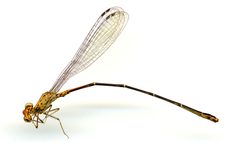
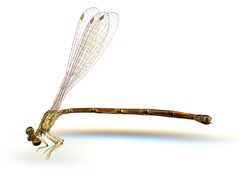
Neoneura amelia, commonly known as Amelia's threadtail, is a small distributed from southern Texas through Central America to Panama. Males display striking scarlet and reddish-orange coloration, while females are drab tan with dark markings. The species inhabits backwaters of large rivers, stream edges, and pond margins, including muddy locations. It is classified as Least Concern by the IUCN due to its wide range and stable .
Pronunciation
How to pronounce Neoneura amelia: //ˌniːoʊˈnjʊrə əˈmiːliə//
These audio files are automatically generated. While they are not always 100% accurate, they are a good starting point.
Identification
Males distinguished by combination of scarlet , thin black thoracic stripe, and reddish-orange abdominal segments. Females may be confused with other small threadtail but can be identified by pale tan base color with discrete black head/ markings and dark abdominal rings; association with males aids identification. Small size and preference (large water bodies away from shore) help separate from similar Neoneura .
Images
Habitat
Backwaters of large rivers and streams; edges of large ponds including muddy margins. Found in wet tropical and subtropical forests, dry forests, and grasslands.
Distribution
Southern Texas (USA) south through Mexico (ten states), Belize, Guatemala, El Salvador, Honduras, Nicaragua, Rica, to Panama.
Seasonality
In Texas, active from April to December; -laying peaks midday.
Behavior
Males hover over water surface well away from shore; sometimes perch concealed in shrubby overhanging vegetation. Females rarely observed except with males. Tandem pairs oviposit on floating wood debris or submerged plant stems, often aggregating with other threadtails and dancer at same locations.
Similar Taxa
- Neoneura aaroniOverlapping range in Central America; N. amelia males distinguished by scarlet (not orange-red) and thoracic coloration and specific abdominal patterning.
- Other Protoneuridae threadtailsShared characteristics of slender and small size; N. amelia distinguished by male color pattern and preference for large water bodies.
More Details
Family Classification
Sources vary in assignment: treated as Protoneuridae in iNaturalist and Catalogue of Life, but as Coenagrionidae in GBIF and NCBI. Protoneuridae is the currently accepted family in modern odonate .
Conservation Status
IUCN assessed as Least Concern; no specific threats identified despite degradation pressures in parts of range.
Sources and further reading
- BugGuide
- Wikipedia
- GBIF taxonomy match
- iNaturalist taxon
- NCBI Taxonomy
- Catalogue of Life
- Why the Bohart Museum of Entomology Rocks! | Bug Squad
- Malaria, Memorial Day and Memories of the Civil War | Bug Squad
- Watch the Science of Entomology Unfold at Bohart Museum of Entomology Open House | Bug Squad
- Honey, What's Going On with the Honey? | Bug Squad
- How Many Species of Moths at Bohart Museum's Moth Night? | Bug Squad
- Introducing Bees to Children | Bug Squad