
Protoneuridae
Tillyard, 1917
Threadtails, Bambootails
Genus Guides
2- Neoneura(Robust Threadtails)
- Protoneura(Slender Threadtails)
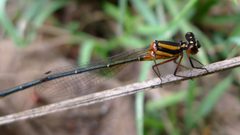
Protoneuridae is a of damselflies (suborder Zygoptera) established by Tillyard in 1917, commonly known as threadtails or bambootails. The family has undergone significant taxonomic revision, with some authorities previously sinking New World into Coenagrionidae and Old World species into Platycnemididae, though Protoneuridae is currently recognized as valid. The family contains 13 distributed primarily in the Neotropics, with greatest diversity in South America. Brazilian fauna alone comprises 64 species in 12 genera.
Pronunciation
How to pronounce Protoneuridae: /ˌproʊtoʊˈnʊrɪˌdiː/
These audio files are automatically generated. While they are not always 100% accurate, they are a good starting point.
Identification
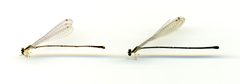
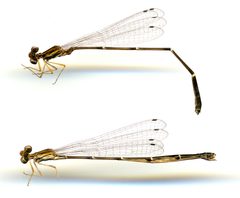
Protoneuridae can be distinguished from related by wing venation patterns and genitalic . Male shape, genital ligula structure, female pronotum morphology, and form are particularly diagnostic at the generic level. Members of the Drepanoneura, for example, differ from Epipleoneura and Epipotoneura in male cercus morphology, genital ligula, female pronotum, and epiproct structure while sharing venational characters. within Neoneura exhibit variation in male appendage, genital ligula, and female pronotum morphology, with multiple color morphs occurring in some species.
Images
Habitat
occupy lotic freshwater . Nososticta kalumburu in northern Australia inhabits rocky streams and pools in sandstone gorges, with larvae in shallow, slow-moving sections containing leaf litter and detritus. remain near larval habitats in riparian vegetation. Neoneura confundens occurs across South America north of the Tropic of Capricorn but is absent from the central and lower Amazon, suggesting habitat specificity within tropical regions.
Distribution
Primarily Neotropical, with 16 and 117 in the region. Brazil harbors 64 species in 12 genera, representing the greatest national diversity. Wide-ranging Brazilian species include Neoneura sylvatica (11 states), Epipleoneura venezuelensis (11 states), and Epipleoneura metallica (eight states). Australian representation includes Nososticta kalumburu in the Kimberley region of Western Australia. Some species have restricted ranges while others show broad distributions with new state and country records continuing to emerge from museum revisions.
Seasonality
Nososticta kalumburu emerges during the wet season (January-March) in northern Australia. are found near water shortly after .
Life Cycle
Aquatic larval development in freshwater . occurs during wet season in at least some (January-March for Nososticta kalumburu). remain near water; mature adults may disperse away from aquatic habitats into surrounding forest.
Behavior
Males of Nososticta kalumburu are territorial, perching on rocks or vegetation over water to defend territories. Mating occurs at water, with males and females remaining in tandem during oviposition into submerged vegetation or debris. Both sexes roost in riparian vegetation. of some disperse to forest away from water after maturation. Strong ability enables of isolated .
Similar Taxa
- CoenagrionidaeNew World Protoneuridae were previously classified within Coenagrionidae in some taxonomic revisions; both share the superfamily Coenagrionoidea and require careful examination of wing venation and genitalic for separation.
- PlatycnemididaeOld World Protoneuridae were previously sunk into Platycnemididae in some classifications; differentiation relies on detailed morphological characters including male and genital ligula structure.
More Details
Taxonomic instability
Protoneuridae has experienced significant taxonomic flux. Recent revisions had classified into Coenagrionidae (New World) and Platycnemididae (Old World), but this has since been revised and Protoneuridae is currently maintained as a distinct . Users should verify current taxonomic treatment in regional literature.
Research gaps
Most Protoneuridae are known only from original descriptions or isolated museum records. The 2009 revision of 2,800 MNRJ specimens extended distributions for 25 species and generated 50 new state records and three new country records, indicating substantial undiscovered range information remains.
Sources and further reading
- BugGuide
- Wikipedia
- GBIF taxonomy match
- iNaturalist taxon
- Catalogue of Life
- Drepanoneura gen. nov. for Epipleoneura letitia and Protoneura peruviensis, with descriptions of eight new Protoneuridae from South America (Odonata: Protoneuridae)
- Checklist and updated distribution of Protoneuridae from Brazil
- On the biology of the damselfly Nososticta kalumburu Watson & Theischinger (Zygoptera: Protoneuridae)
- Influence of the reproductive behavior of Neoneura sylvatica (Odonata: Protoneuridae) on spermatic morphology
- The true identity of Neoneura bilinearis Selys, 1860, with the synonymy of N. gaida Rácenis, 1953, and the description of N. confundens sp. nov. (Odonata: Protoneuridae)