
Lestes dryas
Kirby, 1890
emerald spreadwing, scarce emerald damselfly, robust spreadwing, turlough spreadwing
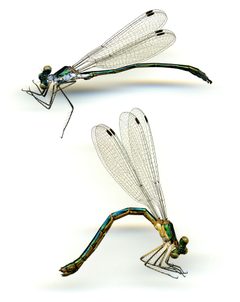
Lestes dryas is a Holarctic in the Lestidae, commonly known as the emerald spreadwing or scarce emerald damselfly. It is notable for being the only Lestes species that occurs in both Europe and North America. The species can tolerate extreme environmental conditions, including slightly brackish water, that few other odonates survive. It has experienced significant declines in parts of its range, particularly in Britain and Ireland, where it was believed extinct before its rediscovery in 1983. Conservation efforts focus on maintaining ditch systems and shallow water that support its aquatic life stages.


Pronunciation
How to pronounce Lestes dryas: //ˈlɛs.teɪz ˈdɹaɪ.əs//
These audio files are automatically generated. While they are not always 100% accurate, they are a good starting point.
Identification
Requires careful separation from the emerald (Lestes sponsa), with which it shares metallic green coloration, bronze iridescence, and black anal appendages. The shape of the anal appendages differs between the two and is the most reliable distinguishing feature. Males of L. dryas have blue versus the brown eyes typical of L. sponsa males. L. dryas is the only Lestes species found in both Europe and North America, which aids identification in these regions. In Europe, it is generally less common than L. sponsa.
Images
Habitat
Inhabits still, shallow water in well-vegetated ditches, ponds, bogs, and lakes. Occurs in dense vegetation near water margins, rarely flying over open water. Tolerates slightly brackish coastal water. Around the Mediterranean, restricted to higher altitudes. Requires maintenance of ditch systems to prevent drying; loss from vegetation overgrowth is a significant threat.
Distribution
Holarctic distribution, primarily between 40° and 60° north latitude. Range extends across central Europe and Asia from France to the Pacific, and across North America. Relictual in North Africa. In Europe, widespread but never abundant; in Britain, restricted to southeast England, Thames Estuary, Norfolk lakes, and Ireland. The only Lestes occurring in both Europe and North America.
Seasonality
fly from April in southern parts of range to late May in northern areas, with peak activity in July and August. laid in late summer undergo through winter, hatching in spring.
Diet
Larvae are active that hunt prey, enabling rapid growth. are predatory, though specific prey items are not documented in available sources.
Life Cycle
are elongated and laid into plant stems (such as rushes) above water, typically in areas that will be submerged as water levels rise in winter. Eggs develop for several weeks, then enter and overwinter. Hatching occurs in spring, producing a prolarval stage lasting minutes to hours—limbless, non-feeding, capable of jumping or wriggling to find water. Upon reaching water, prolarvae to second instar. Larvae actively hunt prey and undergo multiple stadia (number variable); under favorable conditions, final instar (F-0) reached in as little as 8 weeks. produces that require a period of sexual maturation before breeding, during which blue pruinescence develops in males.
Behavior
Tends to stay in dense vegetation near water margins, rarely flying over open water. Mates in wheel position; male remains in tandem with female during oviposition, guarding her while she lays into plant stems above water. are not immediately reproductively mature upon .
Ecological Role
in aquatic and riparian as both larva and . Serves as for conservation of shallow, vegetated wetland . Its presence signals habitat conditions tolerable to few other odonate .
Human Relevance
Subject of conservation concern due to declines; rediscovery in Britain in 1983 prompted protection efforts. Management of ditch systems and water levels directly impacts population persistence. Featured in citizen science and youth conservation projects, such as habitat maintenance at Canvey Wick nature reserve.
Similar Taxa
- Lestes sponsa (emerald damselfly)Shares metallic green body, bronze iridescence, black anal appendages, and half-spread wing posture. Distinguished by anal appendage shape, male color (brown in L. sponsa versus blue in L. dryas), and generally more common and widespread distribution in Europe.
More Details
Conservation Status
Designated as Near Threatened in some regional assessments; declining in England and Ireland with need for active management. Listed as of conservation concern due to specific habitat requirements and sensitivity to ditch drying and vegetation .
Turlough Habitats
In Ireland, known as 'turlough spreadwing' due to association with turloughs—seasonally flooded karstic depressions. This specificity contributes to its conservation significance in the region.
Extreme Tolerance
Among the few odonate capable of surviving in slightly brackish water and other extreme conditions, though mechanism of this is not documented in available sources.
Sources and further reading
- BugGuide
- Wikipedia
- GBIF taxonomy match
- iNaturalist taxon
- NCBI Taxonomy
- Catalogue of Life
- Bohart Bugs Beckon at Vacaville Museum's Exhibit | Bug Squad
- Rosemary Mosco: Butterflies Are Pretty, But They Can Be 'Pretty Gross' | Bug Squad
- Canvey Wick - February Projects with the South East England Youth Nature Network - Buglife Blog - Buglife
- Bug Eric: Bosque del Apache National Wildlife Refuge
- Bug Eric: January 2016
- Lestes dryas kirby—a declining species of dragonfly (odonata) in need of conservation: Notes on its status and habitat in England and Ireland