
Ischnura hastata
(Say, 1840)
Citrine Forktail
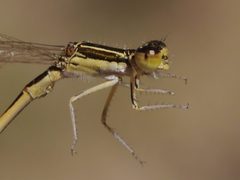
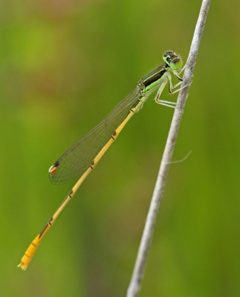
Ischnura hastata, the Citrine Forktail, is a small with remarkable reproductive diversity across its range. Native in North America exhibit typical , while populations in the Azores archipelago represent the only known example of in the order Odonata. A population in the Galápagos Islands has evolved monandry (single mating per female), driven by extremely short lifespans of 1–3 days. The occupies diverse wetland from temperate North America to oceanic islands.

Pronunciation
How to pronounce Ischnura hastata: /ɪsˈnuːrə ˈhæstətə/
These audio files are automatically generated. While they are not always 100% accurate, they are a good starting point.
Images
Habitat
In the Azores, inhabits oligotrophic ponds; absent from eutrophic ponds impacted by cattle grazing and water extraction. In the Galápagos, occurs in wetlands of Isabela Island. North American occupy springs, ponds with emergent vegetation, and slow-moving stream stretches.
Distribution
Native to North America; introduced or established in the Azores archipelago (São Miguel, Pico, Santa Maria, Graciosa, Corvo, Faial, Flores) and the Galápagos Islands (Isabela Island).
Seasonality
active year-round in southern portions of range; reliably April to October in temperate regions. In the Galápagos, adults show very low activity before 7:00, indicating mating does not occur early in the day.
Behavior
Submerged oviposition is common in Azorean , probably evolved as an to unfavorable climatic conditions and to avoid desiccation from water depletion. In the Galápagos, males show strong preference for females of intermediate age (94.3% of mating attempts), rather than young (31.3%) or mature females (24.0%). Males are persistent once tandem is achieved, retaining females for up to 139 minutes, though most females resist and do not copulate. Copulations are brief, averaging 11 minutes.
Similar Taxa
- Ischnura denticollis (Black-fronted Forktail)Both are small forktail in the Ischnura. I. denticollis males lack pale markings on the dorsum of the and have blue restricted to a spot on abdominal segments 8–9, unlike the ring pattern seen in other forktails. I. hastata can be distinguished by its citrine (yellowish) coloration and, in males, different thoracic patterning.
- Ischnura demorsa (Mexican Forktail)Co-occurs with I. hastata in some southwestern U.S. . I. demorsa males typically show blue or green spots or stripes on the , unlike I. hastata's more uniform citrine to green coloration.
Sources and further reading
- BugGuide
- GBIF taxonomy match
- iNaturalist taxon
- NCBI Taxonomy
- Catalogue of Life
- Forgotten tropical plants rediscovered after 100+ years
- Bug Eric: Another Odonata Record
- Bug Eric: New Mexico Dragonfly Blitz - Day 2
- ParthenogeneticIschnura hastatarevisited: present status and notes on population ecology and behaviour (Odonata: Coenagrionidae)
- Sexual conflict and the evolution of monandry: The case of the damselfly Ischnura hastata (Odonata: Coenagrionidae) in the Galápagos Islands