
Ischnura denticollis
(Burmeister, 1839)
Black-fronted Forktail
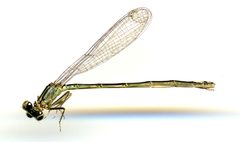
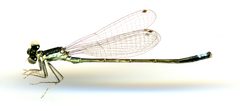
Ischnura denticollis, commonly known as the Black-fronted Forktail, is a small in the Coenagrionidae. It is a western North American with an exceptionally long lifespan for a damselfly, persisting up to six weeks. The species is notable for its distinctive lack of pale thoracic markings, which separates it from most other forktails. It occupies a variety of aquatic including springs, ponds with emergent vegetation, and slow-moving stream sections.
Pronunciation
How to pronounce Ischnura denticollis: /ˈisk.nʷə.rə dɛn.tɪˈkɔlɪs/
These audio files are automatically generated. While they are not always 100% accurate, they are a good starting point.
Identification
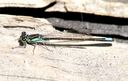
Males are readily identified by the combination of lacking pale thoracic markings and having blue restricted to spots on the abdominal segments rather than complete rings. Females are challenging to distinguish from other forktails and require careful examination. The small size (22–26 mm) and overall dark coloration help narrow possibilities in the western range.
Images
Appearance
Small , 22–26 mm in body length. Males lack the pale blue or green spots or stripes on the dorsum of the that characterize most other forktail . The blue coloration on abdominal segments 8 and 9 is restricted to a spot rather than forming a complete ring around the segments. Females are more difficult to identify and resemble several other forktail species.
Habitat
Occupies springs (both hot and cold), ponds with abundant emergent vegetation, and very slow-moving stretches of streams. Associated with shorelines and edges of water bodies where perching substrates such as rocks and emergent vegetation are available.
Distribution
Western North America from southeast Oregon and southwest Idaho through California, Nevada, western Utah, Arizona, and New Mexico. Absent from the Cascade, Sierra Nevada, and Rocky Mountains but extends north into eastern Colorado and eastward to west Texas, Oklahoma, and Kansas. Also recorded in Central America.
Seasonality
may be encountered year-round in southern portions of the range. In more northern areas, reliably active from approximately April through October. Exceptionally long-lived as adults, with some individuals persisting six weeks and at least one documented case of 42 days.
Life Cycle
Has an unusually extended lifespan compared to most , with adults persisting approximately six weeks under favorable conditions. Specific details of and nymph stages are not documented in available sources.
Behavior
Perches on rocks, emergent vegetation, and other objects near water edges. are known to be long-lived and may remain active in suitable microhabitats for extended periods.
Human Relevance
Subject of odonate surveys and recording efforts; county records and late-season observations are documented by naturalists. IUCN status Least Concern with stable .
Similar Taxa
- Ischnura demorsa (Mexican Forktail)Overlaps in range and ; distinguished by male Mexican Forktail having pale thoracic markings that Black-fronted Forktail lacks
- Other Ischnura forktailsMost other forktail have blue or green spots or stripes on the , which are absent in I. denticollis males
More Details
Conservation Status
IUCN Red List status: Least Concern (). is stable with no immediate threats to survival.