
Enallagma hageni
(Walsh, 1863)
Hagen's Bluet
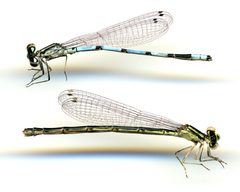
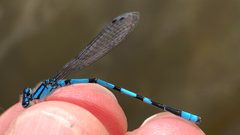
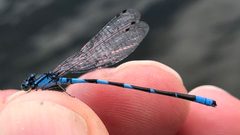
Enallagma hageni is a in the Coenagrionidae, native to North America. It is one of several Enallagma that radiated during the Pleistocene and is closely related to E. ebrium, with which it forms a mosaic spatial distribution pattern. The species is listed as Least Concern by the IUCN with a stable .
Pronunciation
How to pronounce Enallagma hageni: /ɛnəˈlæɡmə ˈheɪɡənaɪ/
These audio files are automatically generated. While they are not always 100% accurate, they are a good starting point.
Identification
Distinguished from the closely related Enallagma ebrium primarily by differences in reproductive structures; the two are morphologically distinct despite genetic similarity. Regional genetic divergence exists between .
Images
Habitat
Associated with wetland including ponds and lakes with emergent vegetation.
Distribution
North America; distribution forms a mosaic pattern with overlapping ranges of E. ebrium, with local dominance of one across extensive areas rather than fine- sympatry.
Diet
Predatory, feeding on small insects captured on the wing.
Life Cycle
Aquatic larval stage (naiad) followed by terrestrial stage. Females deposit on submerged aquatic vegetation, sometimes submerging completely to oviposit.
Behavior
Mating occurs in tandem ; males release females during underwater -laying. are active fliers that hunt by sight.
Ecological Role
in both aquatic (larval) and terrestrial () ; may serve as prey for larger predators.
Similar Taxa
- Enallagma ebriumClosely related with similar preferences; distinguished by reproductive and regional genetic differentiation; rarely sympatric at local sites despite overlapping ranges.
- Enallagma civileCongeneric with similar general ; E. civile is more broadly distributed across North America and is a .
Sources and further reading
- BugGuide
- Wikipedia
- GBIF taxonomy match
- iNaturalist taxon
- NCBI Taxonomy
- Catalogue of Life
- Dragonfly Enthusiasts, Unite! Open House Set Nov. 6 at Bohart Museum | Bug Squad
- Bohart Museum Open House: Dragonflies Rule! | Bug Squad
- Don't Miss the Dragonfly Open House Nov. 6 at Bohart Museum of Entomology | Bug Squad
- Know Your Dragonflies! | Bug Squad
- Hooray for the red, white, and blue! Milkweed longhorned beetle, Tetraopes tetraophthalmus; dogbane tiger moth, Cycnia tenera; and familiar bluet, Enallagma civile — Bug of the Week
- Rising Temperatures Could Stunt Growth, Threaten Survival of Common Damselfly
- Regional divergence and mosaic spatial distribution of two closely related damselfly species (Enallagma hageniandEnallagma ebrium)