
Calopteryx angustipennis
(Selys, 1853)
Appalachian jewelwing
Calopteryx angustipennis, the Appalachian jewelwing, is a large to the eastern United States. It inhabits rocky rivers and streams with cold, fast-flowing water, particularly in woodland settings. are active from spring through summer, with timing varying by latitude.


Pronunciation
How to pronounce Calopteryx angustipennis: /kəˈlɒptrɪks ænˌɡʌstɪˈpɛnɪs/
These audio files are automatically generated. While they are not always 100% accurate, they are a good starting point.
Identification
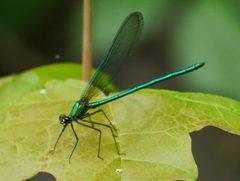
Distinguished from other Calopteryx by the complete absence of dark wing pigmentation. Larger size (50–67 mm versus ~45–55 mm for most ) provides additional separation. The green venation along the wing edge is consistent across both sexes. Females may be confused with other species but show the characteristic dull abdominal tip and reduced metallic intensity.
Images
Appearance
Body length 50–67 mm, making it the largest jewelwing . Both sexes have metallic green and , black legs, and clear to amber wings with green along the upper edge. Wings lack dark pigmentation present in other Calopteryx . Females have less vibrant abdominal coloration with a dull tip, and some pale brown areas on the thorax.
Habitat
Rocky rivers and large streams with cold, fast-flowing water. Strongly associated with woodland , particularly where riffles occur. Occupies both forested stream reaches and more open river sections provided water remains cool and well-oxygenated.
Distribution
to the United States. Range extends from Alabama northward through the Appalachians to New York, covering the southeastern and eastern states.
Seasonality
season begins April–May and ends June–August, with exact timing varying by locale and latitude. appears to follow a relatively compressed schedule within this window.
Behavior
typically perch horizontally on riffles or streamside vegetation, often in small scattered groups. Perching posture and use suggest strong fidelity to flowing water environments. No migratory has been documented.
Similar Taxa
- Calopteryx maculata (Ebony jewelwing)Has distinct dark wing patches; C. angustipennis lacks all dark wing pigmentation
- Calopteryx aequabilis (River jewelwing)Smaller size and different wing pattern; C. angustipennis is notably larger
More Details
Taxonomic note
Described by Selys in 1853. The specific epithet angustipennis (narrow-winged) refers to wing shape relative to some , though the is distinguished more reliably by coloration.