
Calopteryx aequabilis
Say, 1840
River Jewelwing
Calopteryx aequabilis, commonly known as the river jewelwing, is a first described by Thomas Say in 1840. It belongs to the Calopterygidae and is distributed across much of North America, from northeastern Alberta to Nova Scotia and southward through most of the northern United States. The species exhibits pronounced in coloration and wing patterning. It is typically associated with forested stream .
Pronunciation
How to pronounce Calopteryx aequabilis: //kæˈlɒptrɪks iːˈkwæbɪlɪs//
These audio files are automatically generated. While they are not always 100% accurate, they are a good starting point.
Identification
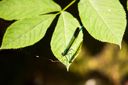
Males distinguished from similar by metallic blue-green body combined with black wing tips; females by dull brown coloration and smoky wings with distinct white spots. The river jewelwing overlaps in range with Calopteryx maculata (ebony jewelwing), which has more extensively darkened wings in both sexes. C. aequabilis can be separated by the limited black wing tips in males and the white-spotted wing tips in females.
Images
Appearance
males have a metallic blue-green body with black wing tips. Adult females are duller brown with smoky wing tips bearing white spots near the tips. Naiads (aquatic larvae) are pale brown with darker markings. The broad, colored wings are characteristic of the Calopterygidae.
Habitat
Small to moderate forest streams with shaded, flowing water. Associated with riparian woodland environments.
Distribution
North America: from British Columbia and northeastern Alberta east to Newfoundland and Nova Scotia; southward through most of the northern United States. Documented from the Klamath River in California.
Life Cycle
Aquatic naiad stage followed by terrestrial stage. Naiads inhabit stream environments.
Human Relevance
Subject of entomological study and nature photography. Featured in museum exhibits and educational materials about Odonata diversity.
Similar Taxa
- Calopteryx maculataOverlapping range and similar size; distinguished by more extensive black wing pigmentation in both sexes, lacking the white wing spots of female C. aequabilis
More Details
Taxonomic history
First described by Thomas Say in 1840. The epithet 'aequabilis' refers to the uniform or even appearance. Sometimes cited as described in 1839 in older literature.