
Erpetogomphus
Selys, 1858
ringtails
Species Guides
6- Erpetogomphus compositus(white-belted ringtail)
- Erpetogomphus crotalinus(yellow-legged ringtail)
- Erpetogomphus designatus(Eastern Ringtail)
- Erpetogomphus elaps(Straight-tipped Ringtail)
- Erpetogomphus eutainia(blue-faced ringtail)
- Erpetogomphus lampropeltis(Serpent Ringtail)
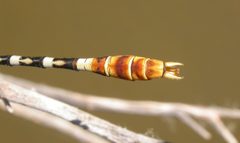
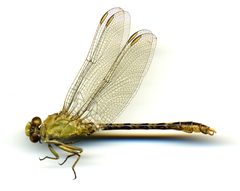
Erpetogomphus is a of in the Gomphidae, commonly known as ringtails. The genus comprises approximately 25 extant distributed primarily in the Americas, plus one fossil species from Early Miocene Mexican amber. Most species exhibit predominantly green coloration, and males possess a moderately clubbed tip. The genus was taxonomically revised by Rosser Garrison in 1994.

Pronunciation
How to pronounce Erpetogomphus: /ˌɛr.pəˈtoʊ.ɡɒm.fəs/
These audio files are automatically generated. While they are not always 100% accurate, they are a good starting point.
Identification
Distinguished from other Gomphidae by the combination of predominantly green thoracic coloration and moderately clubbed male . The solid green with relatively few brown stripes separates Erpetogomphus heterodon from the heavily-striped Erpetogomphus compositus. The turquoise thorax of Erpetogomphus lampropeltis (serpent ringtail) is distinctive. Separation from similar clubtail requires examination of abdominal club development and thoracic pattern specifics.
Images
Appearance
Medium-sized with predominantly green thoracic coloration in most . Males have a moderately clubbed tail ( tip). Specific thoracic patterning varies by species: some have solid green with minimal striping (e.g., Erpetogomphus heterodon, the dashed ringtail), while others display heavily striped thoraxes (e.g., Erpetogomphus compositus, the white-belted ringtail, with a distinctive white central stripe on the thorax side).
Habitat
Associated with rivers and streams; have been observed perching on objects in mid-river or on vegetation overhanging watercourses. The dashed ringtail (E. heterodon) and white-belted ringtail (E. compositus) occur along river systems in the southwestern United States and Mexico. The serpent ringtail (E. lampropeltis) occupies similar lotic .
Distribution
Primarily distributed in the Americas, with records from the United States (southwestern states), Mexico, Central America, and South America. Specific documented from Arizona, New Mexico, and inner Coast Range of California. One fossil species (†Erpetogomphus shii) known from Early Miocene Mexican amber.
Behavior
perch on mid-stream objects and overhanging vegetation. Observed to be relatively approachable, allowing close observation and photography. Mating not specifically documented for this .
Human Relevance
Subject of entomological study and watching; featured in field guides and biodiversity surveys. The white-belted ringtail (Erpetogomphus compositus) has been photographed in California's inner Coast Range. Rosser Garrison's 1994 taxonomic revision of the is a key reference for New World Odonata studies.
Similar Taxa
- OphiogomphusAlso clubtail with green thoracic coloration; distinguished by specific thoracic patterning and abdominal club
- BrechmorhogaClubskimmer that resemble clubtails superficially; distinguished by that meet at the top of the (skimmer characteristic) versus separated eyes in Gomphidae
More Details
Taxonomic Revision
The was comprehensively revised by Rosser Garrison in 1994, resulting in the description of multiple new including Erpetogomphus agkistrodon, E. bothrops, E. elaphe, E. heterodon, E. leptophis, and E. liopeltis.
Fossil Record
†Erpetogomphus shii, described by Zheng et al. in 2018 from Early Miocene Mexican amber, represents the only known fossil in the .
Etymology
Many names reference snakes (e.g., agkistrodon, boa, bothrops, cophias, crotalinus, elaphe, lampropeltis, sipedon, viperinus), reflecting a thematic naming pattern in the .
Sources and further reading
- BugGuide
- Wikipedia
- GBIF taxonomy match
- iNaturalist taxon
- NCBI Taxonomy
- Catalogue of Life
- Dragonfly Enthusiasts, Unite! Open House Set Nov. 6 at Bohart Museum | Bug Squad
- Bohart Museum Open House: Dragonflies Rule! | Bug Squad
- Cataloging Insect and Bat Diversity in Belize | Bug Squad
- Bugs from Belize in the Bohart | Bug Squad
- Bug Eric: New Mexico Dragonfly Blitz - Day 3
- Bug Eric: New Mexico Dragonfly Blitz - Day 2