
Erpetogomphus lampropeltis
Kennedy, 1918
Serpent Ringtail
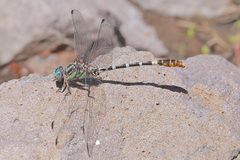
Erpetogomphus lampropeltis, commonly known as the Serpent Ringtail, is a in the Gomphidae (clubtails). It is distinguished by a turquoise and is found in the southwestern United States and Mexico. The species prefers riverine where perch on mid-stream objects or overhanging vegetation. Like other clubtails, it has that are widely separated rather than touching at the top of the .
Pronunciation
How to pronounce Erpetogomphus lampropeltis: /ˌɛr.pɛ.toʊˈɡɑm.fəs ˌlæm.proʊˈpɛl.tɪs/
These audio files are automatically generated. While they are not always 100% accurate, they are a good starting point.
Identification
The turquoise distinguishes E. lampropeltis from other Erpetogomphus . The White-belted Ringtail (E. compositus) has a heavily striped, zebra-like thorax with a white central stripe on the side. The Dashed Ringtail (E. heterodon) has a solid green thorax with relatively few brown stripes. The Serpent Ringtail's preference for perching on mid-stream objects and overhanging river vegetation also aids identification in the field.
Images
Appearance
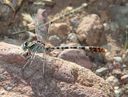
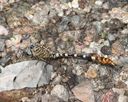
have a turquoise-colored , a distinctive feature among Erpetogomphus . The displays the ringtail pattern characteristic of the , with pale rings on dark segments. are widely separated, typical of Gomphidae. Wings are clear with dark venation. Overall size and proportions are consistent with medium-sized clubtail .
Habitat
Flowing water , particularly rivers and streams. are typically found perched on objects in the middle of watercourses or on vegetation overhanging the water. Associated with the Gila River watershed and similar river systems in the southwestern United States.
Distribution
Southwestern United States (Arizona, New Mexico, possibly adjacent states) and Mexico. Documented from the Gila River and its tributaries in New Mexico, with broader distribution across the region.
Seasonality
Active during summer months, with observations in August documented. and period likely corresponds to monsoon season and warm weather in the desert Southwest, roughly June through September.
Behavior
perch conspicuously on mid-stream rocks and overhanging vegetation, making them relatively approachable for observation and photography. Males likely patrol territories along river stretches. As with other Gomphidae, larvae are aquatic in river substrates.
Ecological Role
are aerial of other insects. Larvae are aquatic predators that contribute to structure in river . The serves as an indicator of healthy, flowing water in arid regions.
Human Relevance
Subject of interest to enthusiasts and photographers due to its distinctive coloration and approachable . Participates in organized dragonfly surveys and 'blitz' events. No documented pest or beneficial status for agriculture or human health.
Similar Taxa
- Erpetogomphus compositusWhite-belted Ringtail has heavily striped, zebra-patterned with white lateral stripe versus turquoise thorax of E. lampropeltis
- Erpetogomphus heterodonDashed Ringtail has solid green with minimal brown striping, lacking the distinctive turquoise coloration
- Ophiogomphus arizonicusArizona Snaketail has almost solid green and belongs to different , though shares riverine
More Details
Taxonomic authority
described by Kennedy in 1918. The Erpetogomphus was taxonomically revised by Rosser Garrison in 1994.
Etymology
Specific epithet lampropeltis references the milky kingsnake Lampropeltis, possibly alluding to ringed pattern or coloration.
Sources and further reading
- BugGuide
- Wikipedia
- GBIF taxonomy match
- iNaturalist taxon
- NCBI Taxonomy
- Catalogue of Life
- Dragonfly Enthusiasts, Unite! Open House Set Nov. 6 at Bohart Museum | Bug Squad
- Bohart Museum Open House: Dragonflies Rule! | Bug Squad
- Bug Eric: New Mexico Dragonfly Blitz - Day 2
- Bug Eric: New Mexico Dragonfly Blitz - Day 3
- Bug Eric: Bosque del Apache National Wildlife Refuge
- Bug Eric: January 2016