
Erpetogomphus compositus
Hagen in Selys, 1858
white-belted ringtail
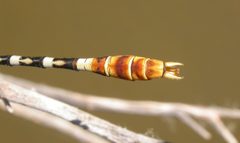
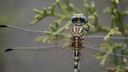
Erpetogomphus compositus, commonly known as the white-belted ringtail, is a clubtail in the Gomphidae. It inhabits streams and rivers in Central America and North America. The is distinguished by its heavily striped with a prominent white central stripe on the side, which gives it the . It is classified as Least Concern by the IUCN with a stable .

Pronunciation
How to pronounce Erpetogomphus compositus: /ˌɛrpɛtoʊˈɡɒmfəs kəmˈpoʊsɪtəs/
These audio files are automatically generated. While they are not always 100% accurate, they are a good starting point.
Identification
The white-belted ringtail can be distinguished from similar ringtail by its heavily striped . The central stripe on the side of the thorax is white, in contrast to the yellow-green patches adjacent to it. This pattern has led to the suggestion that it might be better called the 'zebra ringtail.' It differs from the related Dashed Ringtail (Erpetogomphus heterodon), which has a solid green thorax with relatively few brown stripes.
Images
Habitat
Found along streams and rivers, typically perching on vegetation overhanging water or on objects in the middle of watercourses. Observed in canyon environments and marsh boardwalk areas with emergent vegetation such as cattails.
Distribution
Central America and North America. Documented in the southwestern United States including New Mexico and Arizona, with records from the Gila River watershed and Bosque del Apache National Wildlife .
Behavior
perch on vegetation overhanging water or on objects in mid-stream. They are approachable and relatively easy to photograph compared to some other . Like other clubtails, they are likely to be found along running water rather than still water.
Similar Taxa
- Erpetogomphus heterodonThe Dashed Ringtail has a solid green with relatively few brown stripes, in contrast to the heavily striped thorax of E. compositus with its distinctive white central stripe.
- Erpetogomphus lampropeltisThe Serpent Ringtail has a turquoise and different striping pattern; it also prefers similar riverine .
More Details
Etymology
The 'white-belted ringtail' refers to the prominent white central stripe on the side of the . The epithet 'compositus' is Latin for 'composed' or 'put together,' possibly referring to the complex pattern of stripes on the thorax.
Sources and further reading
- BugGuide
- Wikipedia
- GBIF taxonomy match
- iNaturalist taxon
- NCBI Taxonomy
- Catalogue of Life
- Dragonfly Enthusiasts, Unite! Open House Set Nov. 6 at Bohart Museum | Bug Squad
- Bohart Museum Open House: Dragonflies Rule! | Bug Squad
- Bug Eric: New Mexico Dragonfly Blitz - Day 3
- Bug Eric: Bosque del Apache National Wildlife Refuge
- Bug Eric: January 2016
- Bug Eric: New Mexico Dragonfly Blitz - Day 2