
Nasiaeschna pentacantha
(Rambur, 1842)
Cyrano Darner
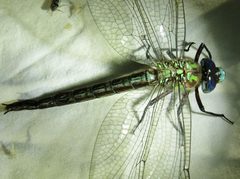
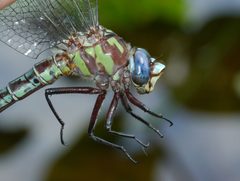
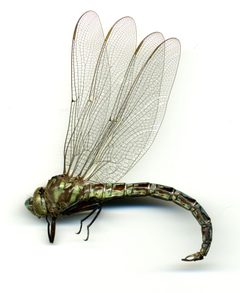
Nasiaeschna pentacantha, commonly known as the Cyrano Darner, is a large in the Aeshnidae. It is distinguished by an exceptionally long, upward-curving that gives the a distinctive profile. The occurs in eastern North America and is associated with forested streams and rivers. are most active in late summer.
Pronunciation
How to pronounce Nasiaeschna pentacantha: /ˌneɪziˈɛsknə ˌpɛntəˈkænθə/
These audio files are automatically generated. While they are not always 100% accurate, they are a good starting point.
Identification
The dramatically elongated, upturned is diagnostic and visible in both field and hand. No other North American darner shows this feature. Green-striped and blue-spotted are shared with other aeshnids but the shape eliminates confusion. In , appears similar to other large darners; close approach or photograph needed for confirmation.
Images
Habitat
Breeds in forested streams and small rivers with moderate current, often with sandy or rocky bottoms. Requires shaded conditions and adjacent mature forest. forage along forest edges, clearings, and roadsides near breeding sites.
Distribution
Eastern North America from Ontario and Quebec south to northern Florida, west to Minnesota and eastern Texas. Core range in Appalachian and Great Lakes regions. Records from Vermont confirmed.
Seasonality
period primarily late July through September in most of range. Peak activity August. One per year ().
Life Cycle
Behavior
Males patrol territories along stream reaches, flying low over water surface. Both sexes forage widely away from water, often at level or along forest edges. Frequently seen hanging vertically from vegetation to rest. Mating occurs at water; males do not guard ovipositing females.
Ecological Role
as both nymph (aquatic , small fish) and (flying insects). Nymphs serve as prey for fish and other aquatic predators.
Human Relevance
No economic significance. Occasionally noted by enthusiasts for its distinctive appearance. Sensitive to stream degradation and forest loss.
Similar Taxa
- Anax spp. (Green Darners and allies)Similar size and coloration, but is short and not upturned; appear larger relative to .
- Aeshna spp. (Mosaic Darners)Share blue-spotted and striped , but have normal proportions and different (higher, more erratic patrolling).
- Epiaeschna heros (Swamp Darner)Similar size and use, but has unpatterned green and normal shape; is faster and more direct.
More Details
Etymology
Specific epithet 'pentacantha' refers to five spines (Greek: penta = five, akantha = spine), likely describing features of the original . name 'Nasiaeschna' combines Greek 'nasos' (island or projecting point) with 'Aeschna', referencing the projecting .
Conservation
Appears secure rangewide but local vulnerable to deforestation and stream siltation. Listed as of special concern in some northeastern states.