
Basiaeschna janata
(Say, 1840)
Springtime Darner
Basiaeschna janata, the Springtime Darner, is a small, bluish in the Aeshnidae. It is the sole member of the Basiaeschna. This is notable for its early seasonal period, appearing in spring when most other darner species have not yet emerged. It is widely distributed across North America.

Pronunciation
How to pronounce Basiaeschna janata: //ˌbæsiˈɛsknə ˈdʒænətə//
These audio files are automatically generated. While they are not always 100% accurate, they are a good starting point.
Identification
Distinguished from other North American darners (Aeshnidae) by its small size, bluish coloration, and early spring period. Most other darner are larger and fly later in the season. The combination of small stature, blue color, and March-May activity period is diagnostic.
Images
Appearance
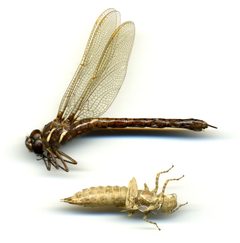
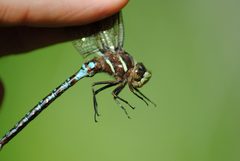
Small darner with bluish coloration. Typical aeshnid body plan with large that meet at the top of the , elongated , and clear membranous wings with dense venation. Bluish and abdomen distinguish it from larger, later-emerging darner .
Habitat
Associated with streams and rivers, particularly in forested or partially wooded areas. Requires clean, flowing water for larval development. patrol along watercourses and adjacent open areas.
Distribution
North America, with records from the United States and Canada. Documented from Vermont and widely across the continent. Global presence indicated but primary range is Nearctic.
Seasonality
Early spring emergent, flying primarily March through May. One of the earliest active darner in its range, with period concluding before most other Aeshnidae species begin to emerge.
Life Cycle
Hemimetabolous development with aquatic nymphal stage in streams and rivers. emerge in early spring, earlier than most sympatric darner . Specific details of deposition and nymphal development duration are not well documented.
Behavior
patrol territories along streams and rivers. Like other darners, likely engages in continuous while foraging and mate-seeking. Early timing may reduce competition with other large .
Ecological Role
Predatory insect in both aquatic (nymph) and terrestrial () life stages. Nymphs prey on aquatic ; adults capture flying insects. Early spring provides predatory function before most other large are active.
Human Relevance
Subject of interest to odonatologists due to its early period and status. Observed and photographed by naturalists; 3292 iNaturalist observations indicate it is frequently encountered and documented by citizen scientists.
Similar Taxa
- Other Aeshnidae speciesLarger size and later period (typically summer) distinguish other darners from B. janata. Most North American darners (Anax, Aeshna, Rhionaeschna) are substantially larger and lack the small, delicate build of the Springtime Darner.
- Gomphidae (clubtails)Some early spring clubtails overlap in and season, but have widely separated and often clubbed tips, unlike the contiguous eyes and unclubbed abdomen of Basiaeschna.
More Details
Taxonomic significance
Basiaeschna is a , making B. janata the only representative of this lineage within Aeshnidae. This suggests a distinct evolutionary trajectory, possibly related to its early-season .
Conservation status
Not formally assessed in major conservation frameworks, but widespread distribution and stream association suggest stable . Early may make vulnerable to unseasonable cold snaps.
Sources and further reading
- BugGuide
- GBIF taxonomy match
- iNaturalist taxon
- NCBI Taxonomy
- Catalogue of Life
- Bug Eric: Fun With Austin Butterfly Forum
- Sphingidae | Beetles In The Bush | Page 2
- The Moth and Me | Beetles In The Bush
- Saturniidae | Beetles In The Bush | Page 2
- Noctuidae | Beetles In The Bush | Page 3
- blog carnivals | Beetles In The Bush