
Zeugomantispa minuta
(Fabricius, 1775)
green mantisfly, green mantidfly
Zeugomantispa minuta, commonly known as the green mantisfly, is a small predatory insect in the Mantispidae. are sit-and-wait that use forelegs to capture prey. Larvae are specialized that develop within spider sacs, feeding on spider eggs. The occurs across the Americas from the Caribbean through Central and North America to South America.
Pronunciation
How to pronounce Zeugomantispa minuta: /ˌzeʊɡoʊˌmænˈtɪspə maɪˈnuːtə/
These audio files are automatically generated. While they are not always 100% accurate, they are a good starting point.
Identification
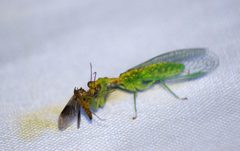
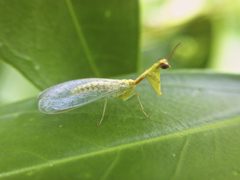
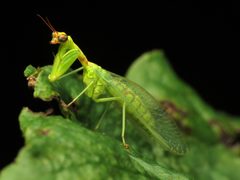
The green mantisfly can be distinguished from praying mantises by its smaller size (under 25 mm vs. 50+ mm for common mantises), roof-like wing posture at rest, and placement in the order Neuroptera rather than Mantodea. Within Mantispidae, it is recognized by its bright green coloration and geographic range. The forelegs with spiny and tibia that close via a hinge mechanism are characteristic of the but shared with mantises due to .
Images
Habitat
Found in diverse terrestrial where spiders and small insects occur. are often observed on vegetation, building walls, and at blacklight stations. Larvae occur within spider sacs. No specific microhabitat requirements are documented beyond association with spider .
Distribution
Widespread across the Americas: Caribbean Sea, Central America, North America (including the United States), and South America. GBIF records confirm presence throughout these regions.
Seasonality
active during warmer months; observed at blacklights in late October in Kansas, suggesting activity extends into autumn in temperate regions. stage unknown for this , though related neuropterans often overwinter as adults.
Diet
: small soft-bodied insects including aphids. Larvae: spider within spider egg sacs (obligate ).
Host Associations
- Spider egg sacs - larval development site and food sourceLarvae penetrate spider sacs and consume spider eggs; may hitch rides on female spiders to reach egg sacs
Life Cycle
Complete with four stages: , larva, pupa, . Larvae are specialized that enter spider egg sacs, either by direct penetration or by phoretic attachment to female spiders. Within the egg sac, larvae feed on spider eggs, then pupate. Adult timing varies by region.
Behavior
are sit-and-wait that remain motionless until prey approaches, then strike with forelegs. Also reported to actively hunt. Frequently attracted to ultraviolet light sources at night. Adults groom their forelegs, which is important for maintaining predatory function.
Ecological Role
Human Relevance
Occasionally encountered by entomologists and naturalists at blacklight stations. No documented economic importance; not considered a pest or beneficial in agriculture. Provides educational value as an example of with praying mantises.
Similar Taxa
- Praying mantises (Mantodea) of forelegs and general body form, but distinguished by larger size, different wing posture, and taxonomic placement in a different order
- Other Mantispidae (e.g., Dicromantispa interrupta, Dicromantispa sayi)Share characteristics but differ in coloration, size, and/or geographic distribution; often co-occur at blacklight stations
Misconceptions
Despite and appearance, mantisflies are not closely related to praying mantises. The similarity is due to , not shared ancestry.
More Details
Convergent evolution
The forelegs of Zeugomantispa minuta evolved independently from those of praying mantises, representing a striking example of similar solutions to predatory challenges arising in unrelated lineages.
Phoretic behavior
First-instar larvae may attach to female spiders and ride to sacs, entering when the spider constructs the sac.
Sources and further reading
- BugGuide
- Wikipedia
- GBIF taxonomy match
- iNaturalist taxon
- NCBI Taxonomy
- Catalogue of Life
- Tiny raptors: Mantisflies, Mantispidae, and Praying mantises, Mantidae — Bug of the Week
- Bug Eric: Last Night to Blacklight?
- Bug Eric: October 2022
- For an Understudied Ant Genus, Two Researchers Choose a "Bird Guide" ID Tool