
Mantispinae
mantidflies, mantispines
Genus Guides
6- Climaciella(wasp mantidflies)
- Dicromantispa
- Entanoneura
- Leptomantispa
- Xeromantispa
- Zeugomantispa(Green Mantidflies)
Mantispinae is a of mantidflies (order Neuroptera) comprising at least 30 and approximately 310 described . are characterized by forelegs adapted for capturing prey, bearing a striking resemblance to praying mantises (Mantodea) due to . Members of this subfamily are distinguished by a larval specialized for of spider sacs.
Pronunciation
How to pronounce Mantispinae: /mænˈtɪspɪniː/
These audio files are automatically generated. While they are not always 100% accurate, they are a good starting point.
Identification
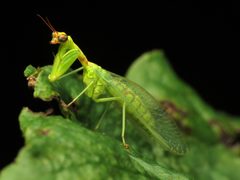
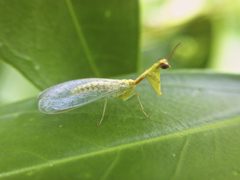
Distinguished from other mantidfly by larval association with spider sacs. may be confused with praying mantises (Mantodea) due to of forelegs, but differ in having two pairs of membranous wings (mantises have leathery forewings), shorter , and different structure. Some resemble in coloration, but possess the characteristic raptorial forelegs of mantidflies.
Images
Appearance
possess highly modified forelegs with sharp spines on the and tibia, forming a hinged grasping mechanism powered by strong internal muscles. The femur and tibia articulate to clamp prey securely. Body size is generally small, with some less than 25 mm in length. Some species exhibit mimicry of , with coloration resembling paper wasps (Polistes spp.) in the Climaciella.
Habitat
frequent vegetation in gardens, meadows, and wildlands where prey insects and spiders occur. Larvae occur exclusively within spider sacs.
Distribution
Worldwide distribution with documented in North America (including central and southeastern Mexico), Australia, and Central America ( Rica). At least 17 species recognized in Australia alone.
Seasonality
are often and attracted to lights, including porch lights and blacklights. Adult lifespan is approximately 3–4 weeks.
Diet
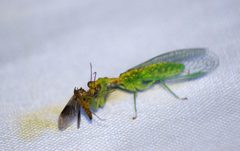
are predatory, feeding on small soft-bodied insects including aphids. They employ sit-and-wait ambush tactics and have been observed to actively hunt. Larvae feed exclusively on spider within egg sacs.
Host Associations
- wolf spiders (Lycosidae) - larval parasitized within egg sacs
- spiders (Araneae) - larval general association; specific ranges vary by mantispid
Life Cycle
Females deposit short-stalked in groups on undersides of leaves. Upon hatching, first-instar larvae either directly seek and penetrate spider egg sacs, or employ a phoretic strategy: larvae wait on vegetation, board a passing female spider, and disembark when she constructs an egg sac. Larvae complete development feeding on spider eggs within the protected egg sac, then pupate. Some larvae may subsist on spider if eggs are not yet available.
Behavior
are sit-and-wait that remain motionless and cryptically colored to ambush prey. They have been observed their legs. Some actively hunt in addition to ambush tactics. Larvae exhibit phoretic , riding on female spiders to locate sacs.
Ecological Role
function as of small insects. Larvae act as of spider , potentially regulating spider . The represents a case of with mantises, demonstrating independent origin of predatory .
Human Relevance
Occasionally encountered in gardens and residential areas. Attracted to artificial lighting, making them observable by homeowners. Some are rare in collections; one collector reported capturing only one specimen in 30 years of blacklighting.
Similar Taxa
- Mantodea (praying mantises) of forelegs for prey capture. Distinguished by wing structure (mantises have leathery tegmina), length, and . Mantises are not closely related; this resemblance is not indicative of shared ancestry.
- Vespidae (paper wasps)Some Mantispinae (e.g., Climaciella brunnea) mimic coloration. Distinguished by forelegs, wing venation, and absence of wasp waist constriction.
More Details
Convergent evolution
The forelegs of Mantispinae and Mantodea represent a classic example of , where similar environmental pressures have shaped analogous morphological structures for prey capture in phylogenetically distant lineages.
Larval host specificity
Different mantispid specialize on different spider species. The green mantisfly Zeugomantispa minuta is restricted to spider sacs, while the broader Mantispidae includes larvae with more varied diets including other larvae.
Sources and further reading
- BugGuide
- Wikipedia
- iNaturalist taxon
- Ever Seen a Mantidfly? | Bug Squad
- Tiny raptors: Mantisflies, Mantispidae, and Praying mantises, Mantidae — Bug of the Week
- Description of the pupa of Climaciella brunnea (Say) (Mantispidae, Mantispinae) and a key to known pupae of mantispids from North America
- A revision of the Australian Mantispidae (Insecta : Neuroptera) with a contribution to the classification of the family. II.* Calomantispinae and Mantispinae