
Machilinae
Genus Guides
2- Mesomachilis(jumping bristletails)
- Trigoniophthalmus
Machilinae is a of bristletails within the Machilidae, comprising one of the two major lineages of the jumping bristletail family. Members are small, wingless insects with the characteristic arched and springing organ () that enables their distinctive jumping locomotion. The subfamily has been historically distinguished from the other machilid subfamily, Petrobiinae, primarily by subtle differences in abdominal appendage structure and patterns. Machilinae are found across temperate and Mediterranean regions, often occupying rocky, coastal, or urban .
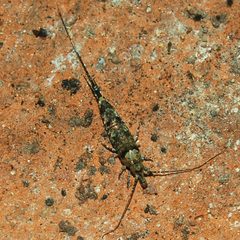
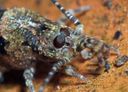
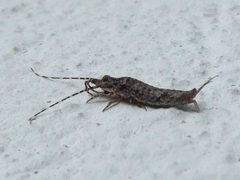
Pronunciation
How to pronounce Machilinae: /məˈkɪlɪnaɪ/
These audio files are automatically generated. While they are not always 100% accurate, they are a good starting point.
Identification
Distinguished from Petrobiinae by the presence of coxal vesicles on abdominal segments 1–7 (versus 2–7 in Petrobiinae) and differences in the structure of the parameres of the male genitalia. on the body are generally broader and more overlapping than in petrobiines. The combination of contiguous , arched , and three long tail filaments separates Machilinae from all other insect orders. -level identification requires examination of genitalia and chaetotaxy.
Images
Appearance
Small to medium-sized wingless insects, 8–15 mm in body length. Body covered with and bristles, giving a silvery or brownish metallic sheen. strongly arched dorsally, creating a humped profile. Large meet dorsally on the . Three long, thread-like caudal appendages ( and paired lateral cerci) extend posteriorly. Abdominal segments bear paired appendages (styli and coxal vesicles) used in locomotion and water absorption. Maxillary palps are long and multi-segmented.
Habitat
Rocky substrates including cliffs, scree slopes, and boulder fields; coastal shingle and supralittoral zones; dry stone walls and building crevices; occasionally in leaf litter and decaying wood. Prefers microhabitats with high humidity and shelter from direct desiccation, such as deep rock crevices or under stones. Many are , colonizing urban environments.
Distribution
Primarily Palearctic, with highest diversity in the Mediterranean Basin, western and central Europe, and the Caucasus. Range extends into northern Africa, the Middle East, and parts of Central Asia. Some introduced to North America and other regions via human commerce. Absent from the native fauna of the Americas, sub-Saharan Africa, and Australia.
Seasonality
Active year-round in mild climates; peak activity in spring and autumn in temperate regions. habits reduce seasonal constraints. occurs as or late instar nymphs in sheltered microhabitats.
Diet
and scavengers. Feeds on decaying plant matter, , lichens, and organic debris. Has been observed consuming dried animal remains and bread crumbs in .
Life Cycle
Ametabolous development: no , with stages (nymphs) resembling in form. Nymphs undergo multiple (typically 9–14 instars) over 1–3 years before reaching sexual maturity. Adults continue to molt throughout life, a rare trait among insects. involves indirect sperm transfer via deposited on substrates, picked up by females. Females lay singly in crevices.
Behavior
foragers that emerge from shelter to feed. Locomotion combines rapid running with characteristic jumping mediated by the , a springing organ that snaps against the substrate. Cannot jump backward like some related groups. When disturbed, seeks immediate shelter in crevices. sometimes form in favorable microhabitats. Males deposit on stalks; females actively seek and collect them.
Ecological Role
Decomposer contributing to nutrient cycling in rocky and coastal . Prey for spiders, , and small vertebrates. Serves as an indicator of stable, minimally disturbed rocky with long-term moisture availability.
Human Relevance
Occasional minor household pest in old buildings with stone foundations or damp walls. Presence indicates moisture problems in structures. No economic damage; generally ignored or unnoticed due to small size and habits. Subject of phylogenetic interest as a basal insect lineage.
Similar Taxa
- PetrobiinaeThe other machilid ; distinguished by coxal vesicle distribution (segments 2–7 versus 1–7) and more slender body form with narrower, less overlapping .
- Meinertellidae of with discontinuous , shorter maxillary palps, and reduced or absent coxal vesicles; lacks the contiguous and long palps of Machilinae.
- Zygentoma (silverfish)Order of wingless insects with flattened bodies, no arched , and no jumping ability; are short or filamentous but not combined with a caudal filament of equal length.
More Details
Phylogenetic significance
Machilinae, together with Petrobiinae, represents the most -rich lineage of . The has been used as a model for studying primitive insect traits including ametabolous development, continued molting in , and indirect sperm transfer. Recent molecular studies have questioned the monophyly of Machilinae as traditionally defined, with some possibly more closely related to Petrobiinae than to other machilines.
Conservation status
No formally assessed by IUCN. Several narrow-range endemics in Mediterranean islands and mountain systems are potentially vulnerable to destruction and climate change. species appear stable or expanding.