
Thesprotia graminis
Scudder, 1878
American grass mantis, grass-like mantis
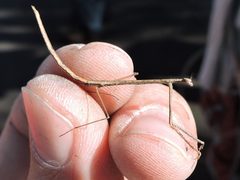
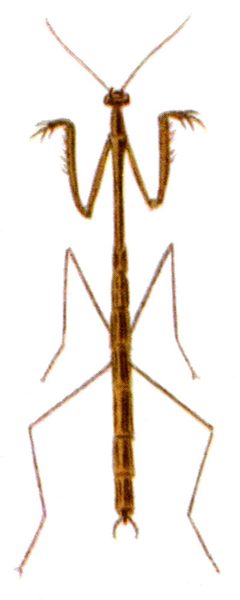
Thesprotia graminis is a small, cryptic native to the southeastern United States. It exhibits remarkable camouflage resembling pine needles or grass blades, achieved through both coloration and posture. The is notable as the only member of its occurring outside South America. It can reproduce both sexually and parthenogenetically.

Pronunciation
How to pronounce Thesprotia graminis: /θɛsˈprɒtiə ˈɡræmɪnɪs/
These audio files are automatically generated. While they are not always 100% accurate, they are a good starting point.
Identification
Light brown to green coloration with extremely elongate, slender body. When forelegs are extended forward, resembles a blade of grass or pine needle. Distinguished from stick insects () by forelimbs with a single large spine. portion of pronotum 3-4 times longer than portion—diagnostic for this . Triangular with small black spots on ridges above terminating in two upward points. males possess wings; adult females are wingless. Males have longer than females. Similar to Brunneria borealis in general appearance.
Images
Habitat
Grasslands, pine stands, thickets, and Spanish moss (Tillandsia usneoides). Particularly well-camouflaged where ground cover is dominated by pine needles.
Distribution
Southeastern United States: Florida, Georgia, South Carolina, Alabama, Mississippi, Louisiana, and Texas. Type locality: Gainesville, Florida.
Diet
Predatory; T. graminis readily feeds on large flies and small to medium-sized .
Life Cycle
Hemimetabolous development: , nymph, . Eggs laid in containing two rows of eggs embedded in hardened frothy material. Females average 3.67 oothecae per lifetime, with subsequent oothecae smaller than the first. Seven nymphal instars in females, six in males. First instar non-feeding and brief; second instar begins hunting. Nymphs lack functional reproductive organs and wings.
Behavior
Employs swaying motion from side to side while extending prothoracic legs forward, similar to stick insects, enhancing grass-blade mimicry.
Ecological Role
of insects; considered beneficial for controlling pest .
Human Relevance
Considered beneficial due to insectivorous diet; aesthetic appeal as charismatic insect.
Similar Taxa
- Brunneria borealisSimilar general appearance in elongate, grass-like body form; distinguished by pronotum proportions and foreleg spine structure
- Phasmatodea (stick insects)Superficial resemblance when forelegs extended forward; distinguished by forelimbs and shape
Sources and further reading
- BugGuide
- Wikipedia
- GBIF taxonomy match
- iNaturalist taxon
- NCBI Taxonomy
- Catalogue of Life
- Encyrtid Holdings | Entomology Research Museum
- Flooding and Bugs – What are the impacts? - Buglife Blog - Buglife
- Grass-like mantid, American grass mantid, Thesprotia graminis, (Scudder, 1878) (Insecta: Mantodea: Thespidae)