
Bistanta mexicana
Saussure & Zehntner, 1894
Slim Mexican Mantis
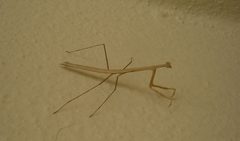
Bistanta mexicana, commonly known as the Slim Mexican Mantis, is a native North American praying mantis and the sole member of the Bistanta in Thespidae. Originally described as Oligonyx mexicana, it has been reclassified into its own genus. The species occurs in California and the southwestern United States, where it inhabits dry, open . It is one of five native mantis species recorded in California.
Pronunciation
How to pronounce Bistanta mexicana: /bɪˈstantə ˌmeksɪˈkɑːnə/
These audio files are automatically generated. While they are not always 100% accurate, they are a good starting point.
Identification
Bistanta mexicana can be distinguished from other native California mantids by its slender body form, reflected in both its scientific and . It differs from the broader-bodied California mantid (Stagmomantis wheeleri/californica) and the bordered (Stagmomantis limbata). Unlike the introduced Chinese mantid (Tenodera sinensis) and European mantid (Mantis religiosa), which are larger and more robust, B. mexicana maintains a notably slim profile. The was formerly placed in Oligonyx but separated based on distinct morphological characteristics.
Images
Habitat
In California, Bistanta mexicana has been observed in dry-mesic upland deciduous forest and similar open woodland . The appears to favor areas with sufficient sunlight and structural vegetation for hunting.
Distribution
Native to southwestern North America. Documented in California, with observations concentrated in the southern and central portions of the state. The ' range extends into adjacent regions of the southwestern United States and northern Mexico, though precise boundaries require further documentation.
Seasonality
Activity period in California appears to span spring through fall, with presence documented from at least April through late summer. Specific varies with local climate conditions.
Life Cycle
Ecological Role
As a native predatory insect, Bistanta mexicana functions as a of small arthropods within its . Its presence contributes to natural of insect in California's native .
Human Relevance
Bistanta mexicana is valued as a component of California's native biodiversity and serves as an educational subject for entomological outreach. The was featured in public education events at the Bohart Museum of Entomology, UC Davis, helping to distinguish native from non-native species in California.
Similar Taxa
- Stagmomantis limbataNative California mantid with broader, more robust body and distinct thoracic patterning; commonly called Arizona or bordered
- Stagmomantis wheeleriNative California mantid (also called S. californica) with stockier build and different pronotum shape
- Tenodera sinensisIntroduced Chinese ; much larger, more robust, with distinctive green or brown coloration and striped eyespot on foreleg
- Mantis religiosaIntroduced European ; larger with characteristic black and white eyespot on inner foreleg surface
- Litaneutria ocularis/obscuraNative small gray ; considerably smaller and more cryptic in appearance
More Details
Taxonomic History
Originally described as Oligonyx mexicana by Saussure & Zehntner in 1894, this was later elevated to its own Bistanta based on distinct morphological characteristics separating it from other Oligonyx species. The genus name Bistanta reflects its slender body form.
Conservation Status
Not formally assessed by IUCN. As a native with documented presence in protected and natural areas, it contributes to regional biodiversity but has not been identified as a species of particular conservation concern.