
Bistanta
Anderson, 2018
Species Guides
1- Bistanta mexicana(Slim Mexican Mantis)
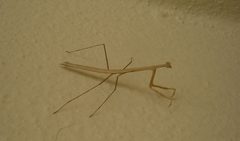
Bistanta is a of praying mantises in the Thespidae, native to Mexico and the Southwestern United States. First described by Anderson in 2018, the genus was previously but now includes five : B. addenda, B. campestris, B. herema, B. mexicana, and B. tolteca. Species in this genus are characterized by their slender, elongated bodies and relatively small . B. mexicana is one of five native mantis species found in California.
Pronunciation
How to pronounce Bistanta: //bɪˈstæn.tə//
These audio files are automatically generated. While they are not always 100% accurate, they are a good starting point.
Identification
Distinguished from other by its notably slender and elongated body proportions combined with a relatively small . The brown to tan coloration (occasionally grayish) helps distinguish it from green-colored mantid in sympatric regions. Within the genus, species-level identification requires examination of specific morphological characters described in Anderson (2022).
Images
Appearance
Slender and elongated body form with a that is relatively small compared to the body. All described are colored in shades of brown or tan, occasionally grayish. Typical mantis with forelegs bearing spines for grasping prey.
Habitat
Found in arid and semi-arid environments of the Southwestern United States and Mexico. Occurs in grasslands, open scrublands, and desert-edge . Specific microhabitat preferences vary by .
Distribution
Native to Mexico and the Southwestern United States. In the United States, recorded from Arizona, Southern Texas, and parts of New Mexico. Range extends southward through Mexico and into parts of Central America.
Ecological Role
Predatory insect contributing to in its native . As with other mantids, functions as a in .
Human Relevance
B. mexicana is recognized as one of five native mantis in California, contributing to regional biodiversity. Not used as biological pest control due to predatory habits.
Similar Taxa
- StagmomantisNative sharing range in Southwestern United States and Mexico; distinguished by more robust body proportions and larger relative size
- LitaneutriaNative in same region; includes small gray that may overlap in but differ in body form and coloration
- Tenodera sinensisIntroduced Chinese found in same region; larger size and green or brown color phases distinguish it from Bistanta
More Details
Taxonomic History
Originally described as a by Anderson in 2018, expanded to five in 2022 with the description of B. addenda, B. campestris, and B. herema by the same author. Two older species (B. mexicana and B. tolteca, described by Saussure & Zehntner in 1894) were transferred into the genus.
Species Composition
The five currently recognized are: Bistanta addenda (Anderson, 2022), Bistanta campestris (Anderson, 2022), Bistanta herema (Anderson, 2022), Bistanta mexicana (Saussure & Zehntner, 1894), and Bistanta tolteca (Saussure & Zehntner, 1894).