
Argyresthia goedartella
(Linnaeus, 1758)
bronze alder moth
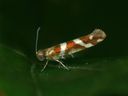
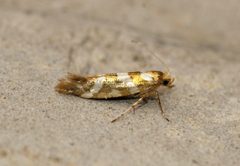
Argyresthia goedartella, commonly known as the bronze alder , is a small moth in the Argyresthiidae. It is widely distributed across Europe and North America. The species is recognized by its distinctive coppery-golden Y-shaped wing marking and its association with birch and alder plants. are active from spring through autumn and have been observed feeding on nectar.
Pronunciation
How to pronounce Argyresthia goedartella: /ˌɑːrdʒɪˈrɛsθiə ˌɡuːdɑːrˈtɛlə/
These audio files are automatically generated. While they are not always 100% accurate, they are a good starting point.
Identification
Distinguished from other Argyresthia by the characteristic coppery-golden Y-shaped marking on the forewings. The combination of white forewings with metallic coppery-golden markings, small size, and association with birch and alder aids identification. Similar species in the may lack the distinct Y-shaped marking or show different metallic pattern arrangements.
Images
Appearance
A small with wingspan of 10–13 mm. pale ochreous with white . Forewings white with coppery-golden markings, including a characteristic Y-shaped marking in the center. Hindwings dark gray. grayish fuscous. Legs brownish white.
Habitat
Associated with stands of birch (Betula) and alder (Alnus glutinosa). Larval includes shoots and hard male catkins of plants. habitat extends to areas where host trees occur, including open woodlands and forest edges.
Distribution
Widespread across most of Europe and North America. Confirmed present in Belgium at national and provincial levels (Antwerpen, Brussels-Capital Region, Flemish Region, Walloon Region).
Seasonality
. fly from May to October, with peak activity varying by region. season data primarily from Belgium and The Netherlands; timing may differ in other parts of the range. Larvae overwinter in plant shoots or catkins, pupating in late March or April.
Diet
feed on nectar, particularly from tansy (Tanacetum vulgare). Larvae feed on birch (Betula ) and alder (Alnus glutinosa), mining within shoots or hard male catkins.
Host Associations
- Betula - larval plantlarvae feed on birch
- Alnus glutinosa - larval plantlarvae feed on alder, overwinter in shoots or hard male catkins
- Tanacetum vulgare - nectar source observed feeding on tansy nectar
Life Cycle
. laid on plants. Larvae feed internally on birch or alder, in shoots or hard male catkins. In late March or April, larvae congregate and pupate in cocoons constructed under bark. emerge from May through October.
Behavior
fly at night and on sunny afternoons. Larvae are internal feeders (miners) within plant tissues. Larvae congregate before . Adults have been observed visiting flowers for nectar.
Ecological Role
Larval herbivore on birch and alder, acting as a leaf/ shoot miner. when feeding on nectar. Serves as prey for various . Part of the guild of microlepidopteran on Betulaceae plants.
Human Relevance
No significant economic or agricultural impact reported. Of interest to lepidopterists and naturalists. 'bronze alder ' reflects its association with alder and distinctive metallic wing markings.
Similar Taxa
- Other Argyresthia speciesSimilar size, white ground color, and metallic markings; distinguished by specific pattern of coppery-golden markings, particularly the Y-shaped marking in A. goedartella
More Details
Taxonomic placement
placement has varied in literature; listed as Argyresthiidae in most modern sources, though some references place in Yponomeutidae. Basionym Phalaena goedartella Linnaeus, 1758.
Identification challenges
As with many microlepidoptera, definitive identification may require examination of genitalia characters. External markings are generally reliable for this within its range.