
Sparganothis umbrana
Barnes & Busck, 1920
Birdsfoot Trefoil Leaftier
Sparganothis umbrana is a small tortricid described by Barnes and Busck in 1920. It is known from a broad range of North American localities spanning Canada and the United States. The has been recorded feeding on Euphorbia esula as a larva. Its , Birdsfoot Trefoil Leaftier, suggests an association with Lotus corniculatus, though this relationship requires verification.

Pronunciation
How to pronounce Sparganothis umbrana: /spɑrɡəˈnoʊθɪs ʌmˈbreɪnə/
These audio files are automatically generated. While they are not always 100% accurate, they are a good starting point.
Identification
The small wingspan (18–19 mm) distinguishes it from larger Sparganothis . Definitive identification requires examination of genitalia or reference to original description. It may be confused with other small tortricids in the Sparganothis; dissection or molecular methods are recommended for reliable determination.
Images
Appearance
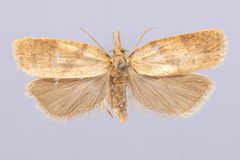
have a wingspan of 18–19 mm. As a member of Tortricidae, it likely exhibits the characteristic bell-shaped wing posture at rest, though specific coloration and pattern details are not documented in available sources.
Habitat
Associated with areas where its recorded plant Euphorbia esula (leafy spurge) occurs. This includes disturbed grasslands, roadsides, and open fields. The suggests potential association with agricultural or semi-natural grasslands where Lotus corniculatus grows.
Distribution
Recorded from Alberta, Colorado, Iowa, Maryland, Nevada, New Brunswick, New Jersey, New York, Newfoundland, Ohio, Ontario, Oregon, Quebec, Saskatchewan, South Carolina, and Vermont. This represents a transcontinental North American range with concentration in northeastern and north-central regions.
Diet
Larvae have been recorded feeding on Euphorbia esula (leafy spurge). The 'Birdsfoot Trefoil Leaftier' implies larval feeding on Lotus corniculatus, but this association is not confirmed in primary literature.
Host Associations
- Euphorbia esula - larval leafy spurge; only confirmed in literature
Ecological Role
As a herbivore on Euphorbia esula, larvae may contribute to of this plant. Euphorbia esula is a noxious weed in North America; native herbivores that feed on it are of interest for integrated weed management, though the efficacy of S. umbrana in this role has not been quantified.
Human Relevance
Potential interest as a biocontrol agent for leafy spurge (Euphorbia esula), a significant agricultural and rangeland weed. No documented economic damage to crops. Not known to be a pest of birdsfoot trefoil despite .
Similar Taxa
- Sparganothis fruitwormCongeneric mentioned as cranberry pest; S. umbrana distinguished by smaller size and different association
- Other Sparganothis species contains multiple small tortricids; reliable separation requires genitalia examination or plant association
Misconceptions
The 'Birdsfoot Trefoil Leaftier' suggests a confirmed relationship with Lotus corniculatus, but published literature only documents Euphorbia esula as a larval host. The trefoil association may reflect observation, misidentification, or conflation with related .
More Details
Taxonomic note
Original description by Barnes & Busck (1920). The remains poorly studied with limited biological data beyond record and distribution.
Research context
Mentioned in climate change studies as part of the Sparganothis being investigated for potential impacts on cranberry pests, though S. umbrana itself is not a cranberry pest.