
Agapeta zoegana
(Linnaeus, 1767)
sulphur knapweed moth, yellow-winged knapweed root moth, knapweed root moth
A small, bright yellow native to Eurasia, introduced to North America in the 1980s as a agent for knapweeds (Centaurea maculosa and C. diffusa). The larva is a root miner that tunnels through the root cortex, causing moderate to considerable damage to plants. are short-lived, with activity from May to August. The has established in western North America and is compatible with other knapweed biocontrol agents.
Pronunciation
How to pronounce Agapeta zoegana: /ˌæɡəˈpiːtə zoʊˈɡɑːnə/
These audio files are automatically generated. While they are not always 100% accurate, they are a good starting point.
Identification
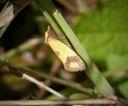
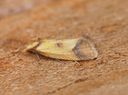
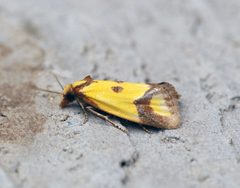
Bright yellow forewings with distinct brown terminal blotch and costal markings; dark grey hindwings. Distinguished from similar tortricids by the combination of yellow ground color with ferruginous-fuscous patterning and association with knapweed . Z-11-tetradecenyl acetate is a documented sex attractant for monitoring.
Images
Appearance
are bright yellow with brown markings. Forewings have a moderately arched , with the costal edge, a small spot before the middle, and a large terminal blotch with angulated edge in ferruginous-fuscous brown. Hindwings are dark grey. Body length approximately 11 mm.
Habitat
Open, disturbed supporting knapweed . In native range, occurs in areas with Centaurea . In introduced range, established in spotted and diffuse knapweed in western and west-central North America. Larval habitat is within the root crown and root cortex of plants.
Distribution
Native to Eurasia, widely distributed across central and southeastern Europe including eastern Austria, northwestern Hungary, central Hungary, and Alsace region. Introduced to North America starting in 1980s; established in western and west-central United States and southwestern Canada (British Columbia since 1984).
Seasonality
from May to August, with peak varying by cohort and release . Emergence occurs from dusk and adults are attracted to light. Overwinters as larva in root.
Diet
Larva feeds on root tissues: early instars mine epidermal tissues of the root crown; older instars tunnel through root cortex and endodermis. plants are restricted to Centaurea , particularly spotted knapweed (Centaurea maculosa) and diffuse knapweed (C. diffusa).
Host Associations
- Centaurea maculosa - primary tetraploid North American form is main target for biocontrol
- Centaurea diffusa - primary ; established on in British Columbia since 1984
- Centaurea vallesiaca - documented in European literature
Life Cycle
laid on stems and leaves. Larva mines root crown , then moves to root and tunnels through cortex; can migrate below ground to new if initial plant destroyed. Overwinters as larva within root. occurs in root; June through August. Several per year may occur. Adult lives only a few days.
Behavior
fly from dusk and are attracted to light. Larvae exhibit active searching ability and can migrate underground to locate new plants when initial host is destroyed. Under high larval densities, earlier and may occur, possibly due to resource depletion or crowding.
Ecological Role
Root herbivore and agent for knapweeds. Reduces knapweed spread in areas where mechanical and chemical control is impractical. Predominantly attacks rosette stage, which is the most sensitive stage for knapweed . Compatible with other knapweed biocontrol agents including Pelochrista medullana and seed-feeding .
Human Relevance
Intentionally introduced to North America for of noxious knapweeds. Approved for release in Canada and USA. Monitored using synthetic sex attractant (Z-11-tetradecenyl acetate). Reduces knapweed below in rangeland and pasture systems.
Similar Taxa
- Pelochrista medullanaAnother knapweed root-feeding in Tortricidae; co-occurs in biocontrol programs but distinguished by different and
- Other Cochylidae/TortricidaeAgapeta zoegana distinguished by bright yellow coloration with brown terminal blotch, specific association with Centaurea, and documented chemistry
More Details
Biocontrol efficacy
Optimal production achieved with releases greater than 1.6 male-female pairs per spotted knapweed plant. Larval densities in native range reach 23.6 larvae per 100 roots in eastern Austria/northwestern Hungary.
Taxonomic note
placement has been cited as both Tortricidae and Cochylidae in literature; currently accepted in Tortricidae ( Tortricinae, tribe Cochylini).
Sources and further reading
- BugGuide
- Wikipedia
- GBIF taxonomy match
- iNaturalist taxon
- NCBI Taxonomy
- Catalogue of Life
- BIOLOGY OF AGAPETA ZOEGANA (LEPIDOPTERA: COCHYLIDAE), PROPAGATED FOR THE BIOLOGICAL CONTROL OF KNAPWEEDS (ASTERACEAE)
- FIRST REPORT OF THE ESTABLISHMENT OF AGAPETA ZOEGANA L. (LEPIDOPTERA: COCHYLIDAE) ON SPOTTED KNAPWEED, CENTAUREA MACULOSA LAMARCK, IN THE UNITED STATES
- Z-11-TETRADECENYL ACETATE: SEX ATTRACTANT OF AGAPETA ZOEGANA (LEPIDOPTERA: TORTRICIDAE), A POTENTIAL SPECIES FOR THE BIOLOGICAL CONTROL OF KNAPWEED
- Growth pattern of diploid and tetraploid spotted knapweed, Centaurea maculosa Lam. (Compositae), and effects of the root‐mining moth Agapeta zoegana (L.) (Lep.: Cochylidae)
- AGAPETA ZOEGANA (L.) (LEPIDOPTERA: COCHYLIDAE), A SUITABLE PROSPECT FOR BIOLOGICAL CONTROL OF SPOTTED AND DIFFUSE KNAPWEED, CENTAUREA MACULOSA MONNET DE LA MARCK AND CENTAUREA DIFFUSA MONNET DE LA MARCK (COMPOSITAE) IN NORTH AMERICA