
Agapeta
Hübner, 1822
Species Guides
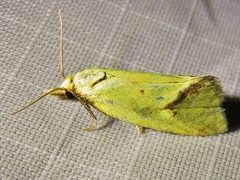
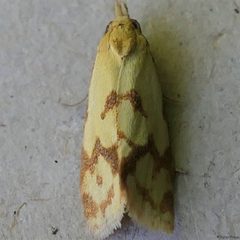
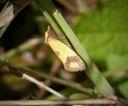
1- Agapeta zoegana(sulphur knapweed moth)
Agapeta is a of tortricid moths in the Tortricinae. The genus includes at least four described , with A. zoegana (the knapweed root-borer ) being the most extensively studied due to its use as a agent for knapweeds in North America. Larvae are root-feeding , and the genus is native to Eurasia with some species introduced to North America for weed management.
Pronunciation
How to pronounce Agapeta: /ˌæɡəˈpiːtə/
These audio files are automatically generated. While they are not always 100% accurate, they are a good starting point.
Identification
Members of Agapeta can be distinguished from similar cochyline tortricids by genitalic characters and larval associations. A. zoegana specifically is identified by its association with knapweed roots and can be monitored using Z-11-tetradecenyl acetate as a sex attractant.
Images
Habitat
Root systems of herbaceous plants, particularly Centaurea (knapweeds). Larvae inhabit the root crown, cortex, and endodermis of plants. occur in open where host plants grow.
Distribution
Native to Eurasia, with records from central and southeastern Europe, Scandinavia (Denmark, Norway, Sweden), and eastern Austria through northwestern Hungary. A. zoegana has been introduced and established in southwestern Canada (British Columbia since 1984) and the northwestern United States.
Seasonality
of A. zoegana emerge June through August in North America. The is facultatively multivoltine, with several per year possible depending on conditions.
Diet
Root tissues of plants. A. zoegana larvae feed on epidermal tissues of the root crown (early instars) and root cortex and endodermis (older larvae). The appears restricted to Centaurea based on available host records.
Host Associations
- Centaurea diffusa - diffuse knapweed; target for
- Centaurea maculosa - spotted knapweed; primary target for
Life Cycle
Overwinters as larva in root. occurs in spring or early summer. emerge June through August. Several per year may occur in favorable conditions. Larval development includes root-mining stages: early instars mine root crown , older larvae mine deeper root tissues.
Behavior
Larvae are root-mining that can migrate below ground to new plants if the initial host is destroyed. Higher larval densities may induce earlier , possibly due to resource depletion or crowding. respond to -specific sex attractants (Z-11-tetradecenyl acetate in A. zoegana).
Ecological Role
Root-feeding herbivore and agent. A. zoegana acts as a of knapweed roots, causing damage that can reduce plant survival, particularly of rosette-stage plants. The is compatible with other knapweed biological control agents including Pelochrista medullana.
Human Relevance
Used as a agent for spotted and diffuse knapweed in North America. Approved for release in Canada and the United States. Monitored using synthetic sex attractants to track establishment and spread.
Similar Taxa
- Pelochrista medullanaAnother knapweed root-feeding cochyline introduced to North America; differs in being a seed- feeder rather than root feeder, and the two are considered compatible for combined
- Other Cochylini generaSimilar tortricine but distinguished by genitalic characters and associations; many lack the specialized root-mining habit on Centaurea
More Details
Taxonomic placement note
Sources variously place A. zoegana in Tortricidae or Cochylidae; this reflects historical taxonomic changes. Current classification (Catalogue of Life) places Agapeta in Tortricidae: Tortricinae: Cochylini.
Biological control efficacy
A. zoegana predominantly attacks the rosette stage of knapweeds, which models identify as the most sensitive stage for determining equilibrium weed . Optimal production in controlled settings occurs at >1.6 pairs per spotted knapweed plant.
Sources and further reading
- BugGuide
- Wikipedia
- GBIF taxonomy match
- iNaturalist taxon
- NCBI Taxonomy
- Catalogue of Life
- BIOLOGY OF AGAPETA ZOEGANA (LEPIDOPTERA: COCHYLIDAE), PROPAGATED FOR THE BIOLOGICAL CONTROL OF KNAPWEEDS (ASTERACEAE)
- FIRST REPORT OF THE ESTABLISHMENT OF AGAPETA ZOEGANA L. (LEPIDOPTERA: COCHYLIDAE) ON SPOTTED KNAPWEED, CENTAUREA MACULOSA LAMARCK, IN THE UNITED STATES
- Z-11-TETRADECENYL ACETATE: SEX ATTRACTANT OF AGAPETA ZOEGANA (LEPIDOPTERA: TORTRICIDAE), A POTENTIAL SPECIES FOR THE BIOLOGICAL CONTROL OF KNAPWEED
- Growth pattern of diploid and tetraploid spotted knapweed, Centaurea maculosa Lam. (Compositae), and effects of the root‐mining moth Agapeta zoegana (L.) (Lep.: Cochylidae)
- AGAPETA ZOEGANA (L.) (LEPIDOPTERA: COCHYLIDAE), A SUITABLE PROSPECT FOR BIOLOGICAL CONTROL OF SPOTTED AND DIFFUSE KNAPWEED, CENTAUREA MACULOSA MONNET DE LA MARCK AND CENTAUREA DIFFUSA MONNET DE LA MARCK (COMPOSITAE) IN NORTH AMERICA