
Cnephasia longana
(Haworth, 1811)
Long-winged Shade, Omnivorous Leaftier Moth, Strawberry Fruitworm
Cnephasia longana is a small tortricid native to western Europe and introduced to western North America. show strong in wing coloration. The is notable for its broad larval diet spanning multiple plant and its status as a pest of cereal crops. First-instar larvae overwinter in bark crevices before resuming feeding in spring.
Pronunciation
How to pronounce Cnephasia longana: /knɛˈfeɪʒə lɒŋˈɡɑːnə/
These audio files are automatically generated. While they are not always 100% accurate, they are a good starting point.
Identification
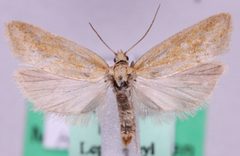
Distinguished from similar Cnephasia by the combination of: elongate forewings with nearly straight ; male unicolorous whitish-ochreous forewings (not banded or spotted); female with characteristic excavated central fascia and diffusely connected costal patch; stalked hindwing 6 and 7. in coloration is pronounced and diagnostic. Larval breadth may aid identification where reared.
Images
Appearance
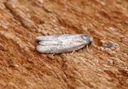
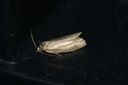
Forewings 7.5–10.8 mm, elongate with hardly arched; apex at or near 7. Male: whitish-ochreous, unicolorous, antennal cilia short. Female: pale greyish-ochreous with angulated fascia at 1/3, central fascia with edge excavated mid-dorsally, costal patch diffusely connected to central fascia beneath costa in brownish tones. Hindwings whitish-ochreous, variably suffused with grey; veins 6 and 7 stalked. Larva pale yellowish with greenish-grey and lines, black spots, pale brown and prothoracic plate.
Habitat
Downland, rough ground, and agricultural areas including cereal fields. Larval microhabitat includes leaf mines and tied leaves of herbaceous plants; sites are bark crevices.
Distribution
Native to western Europe: Scandinavia to Iberian Peninsula, including Sardinia, Sicily, Crete; Ireland to Poland. Introduced to western North America: southern British Columbia, Washington, Oregon, California. Reported from north-western Africa and Asia.
Seasonality
: late March to early July in California; July to August in western Europe. Larvae active in spring following as first instars.
Diet
Larvae feed on herbaceous plants across Asteraceae, Convolvulaceae, Fabaceae, Geraniaceae, Hydrophyllaceae, Linaceae, Papaveraceae, Polygonaceae, Rosaceae, Scrophulariaceae, and Violaceae. Considered a pest on cereal crops. Early instars mine leaves; later instars tie leaves.
Host Associations
- Asteraceae - larval food plantmultiple
- Convolvulaceae - larval food plantmultiple
- Fabaceae - larval food plantmultiple
- Geraniaceae - larval food plantmultiple
- Hydrophyllaceae - larval food plantmultiple
- Linaceae - larval food plantmultiple
- Papaveraceae - larval food plantmultiple
- Polygonaceae - larval food plantmultiple
- Rosaceae - larval food plantmultiple ; includes strawberry
- Scrophulariaceae - larval food plantmultiple
- Violaceae - larval food plantmultiple
- Poaceae - larval food plantcereal crops; pest status
Life Cycle
First-instar larvae hibernate in bark cracks or crevices. In spring, larvae initially mine plant leaves, then proceed to tie leaves. details not specified in sources. timing varies by region.
Behavior
Larvae exhibit leaf-tying after initial leaf-mining phase. first instars seek sheltered bark crevices. activity implied by .
Ecological Role
Herbivore with broad range; contributes to leaf damage in herbaceous plant . Pest status in agricultural systems indicates potential economic impact on cereal production.
Human Relevance
Considered a pest of cereal crops. 'strawberry fruitworm' suggests damage to strawberry, though explicit fruit damage not detailed in sources. Subject of entomological study due to wide range and status in North America.
Similar Taxa
- Cnephasia asseclanaSimilar elongate forewing shape; distinguished by male forewing pattern and female fasciation details
- Cnephasia pasiuanaOverlapping European distribution; C. longana differs in male unicolorous forewings and specific female pattern elements
More Details
Nomenclatural history
Originally described as Tortrix longana by Adrian Hardy Haworth in 1811; basionym preserved in synonymy.