
Clepsis persicana
(Fitch, 1856)
white triangle tortrix, green needleworm
Clepsis persicana is a tortricid found across North America from Alaska and British Columbia to Newfoundland, south to Virginia, and west to California. are active from June to August, with one per year. The is notable for its broad plant range, with larvae feeding on both deciduous and coniferous trees.
Pronunciation
How to pronounce Clepsis persicana: /ˈklɛp.sɪs pɜrˈsɪ.kə.nə/
These audio files are automatically generated. While they are not always 100% accurate, they are a good starting point.
Identification
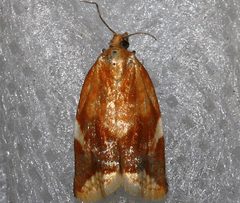
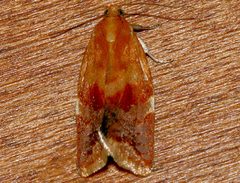
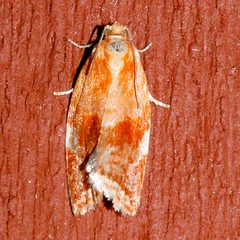
Distinguished from similar Clepsis by the pale termen contrasting with darker purplish forewing coloration. The combination of orange basal forewing color with dark purplish area and pale termen is diagnostic. Larvae are recognized by their slender, active habit, yellow , and greyish body stripes.
Images
Appearance
Forewings measure 8.5–10.5 mm in males and 10–11 mm in females. Forewings are orange basally, becoming darker and purplish toward the termen, which is pale. Larvae are slender and very active, with a yellow and wide, indistinct greyish stripes on the body; body color is yellowish-green or greyish-green with a yellowish-brown head.
Habitat
Coniferous and mixed coniferous forests.
Distribution
North America: Alaska and British Columbia east to Newfoundland, south to Virginia, and west to California. Canadian provincial records include Alberta, Manitoba, and Saskatchewan.
Seasonality
on wing June to August in one per year. Larvae present from April to June; in Ontario, collected in late May and June.
Diet
Larvae feed on a wide range of deciduous and coniferous trees including: Acer (including A. negundo), Alnus (including A. viridis, A. incana), Betula (including B. papyrifera, B. nana), Abies (including A. balsamea, A. concolor, A. lasiocarpa), Picea (including P. glauca, P. engelmannii), Pinus (including P. banksiana), Pseudotsuga (including P. menziesii), Larix (L. occidentalis), Populus (including P. tremuloides, P. balsamifera), plus Osmorhiza, Solidago, Corylus, Cornus canadensis, Rhododendron canadense, Vaccinium, Frasera (including F. fastigiata), Ribes, Maianthemum canadense, Comptonia peregrina, Fraxinus, Ceanothus, Malus pumila, Prunus (including P. virginiana, P. persica), Rosa, Rubus, Salix, and Ulmus.
Life Cycle
Overwinters as a mid-instar larva. occurs under bark of plant or among fallen leaves at base of tree. One per year.
Behavior
Young larvae lower themselves on silk threads to search for abandoned shelters of other Tortricidae . If no shelter is found, they feed on cover plants on the ground. Larvae web leaves of plants and feed in the calyx.
Ecological Role
Leafroller that contributes to nutrient cycling through herbivory on diverse tree . Larval shelter-seeking may facilitate commensal or competitive interactions with other tortricid species.
Human Relevance
Not considered an economically significant pest; control measures have not been needed.
Similar Taxa
- Clepsis peritanaGarden tortrix, distinguished by different forewing pattern and preferences; C. persicana has distinctive pale termen and broader conifer host range.
Sources and further reading
- BugGuide
- Wikipedia
- GBIF taxonomy match
- iNaturalist taxon
- NCBI Taxonomy
- Catalogue of Life
- Blacklighting at the Bohart: They Saw the Light | Bug Squad
- What Will You See at Bohart Museum Open House | Bug Squad
- Oh, What a (Moth) Night! | Bug Squad
- Mark Your Calendar for 'Moth Night' at Bohart Museum: July 30 | Bug Squad
- A Night at the Bohart Museum: Moth Night on Saturday, July 22 | Bug Squad
- Bug Eric: National Moth Week Recap for Colorado Springs