
Clepsis consimilana
(Hübner, [1814-1817])
privet tortrix
Clepsis consimilana, commonly known as the privet tortrix, is a small tortricid with a wingspan of 13–19 mm. are active from June to September, with a partial second occurring in September. The larvae feed on various woody plants, particularly Ligustrum (privet) , and prefer dead leaves. The species has a broad distribution spanning Europe, Asia Minor, Syria, North Africa, and the eastern United States.
Pronunciation
How to pronounce Clepsis consimilana: /ˈklɛpsɪs kɒnsɪmɪˈlɑːnə/
These audio files are automatically generated. While they are not always 100% accurate, they are a good starting point.
Identification
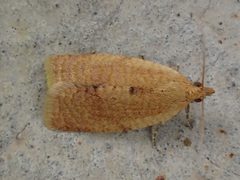
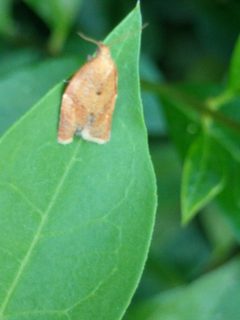
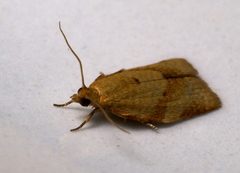
Distinguished from similar Clepsis by the combination of reddish-brown forewings with dark brown markings and two small dark spots on the hind edge. Females are less distinctly marked than males. The violet green or violet grey larvae with pale brown provide additional identification cues.
Images
Habitat
Associated with woody vegetation, particularly areas containing Ligustrum (privet) and other plants. Larvae feed in rolled or folded leaves.
Distribution
Europe to Asia Minor and Syria; North Africa; eastern United States.
Seasonality
on wing June to September. Partial second occurs in September. Third instar larvae hibernate.
Diet
Larvae feed on various trees and shrubs including Ligustrum (preferred), Syringa, Hedera, Lonicera, Polygonum, Malus, Carpinus, Crataegus, and Cotoneaster. Larvae apparently prefer dead leaves.
Host Associations
- Ligustrum - larval food plantpreferred
- Syringa - larval food plant
- Hedera - larval food plant
- Lonicera - larval food plant
- Polygonum - larval food plant
- Malus - larval food plant
- Carpinus - larval food plant
- Crataegus - larval food plant
- Cotoneaster - larval food plant
Life Cycle
hatch into larvae that feed on plant leaves, rolling or folding leaves for shelter. occurs in the larval feeding place. emerge June to September. A partial second occurs in September, with third instar larvae entering hibernation.
Behavior
are active in afternoon and evening and come to light. Larvae roll or fold leaves to conceal themselves from and .
Ecological Role
Larval leaf-roller that contributes to nutrient cycling through consumption of dead leaves. Serves as prey for various including .
Human Relevance
Minor pest potential on cultivated Ligustrum (privet) and other ornamental shrubs. The 'privet tortrix' reflects its association with privet hedges.
Similar Taxa
- Clepsis peritanaBoth are small tortricid moths with similar leaf-rolling larval , but C. peritana is known as the Garden Tortrix and has different forewing pattern and coloration.
More Details
Hibernation
Third instar larvae hibernate, resuming development in spring.
Light attraction
are readily attracted to ultraviolet light sources.
Sources and further reading
- BugGuide
- Wikipedia
- GBIF taxonomy match
- iNaturalist taxon
- NCBI Taxonomy
- Catalogue of Life
- Blacklighting at the Bohart: They Saw the Light | Bug Squad
- What Will You See at Bohart Museum Open House | Bug Squad
- Oh, What a (Moth) Night! | Bug Squad
- Mark Your Calendar for 'Moth Night' at Bohart Museum: July 30 | Bug Squad
- A Night at the Bohart Museum: Moth Night on Saturday, July 22 | Bug Squad
- Bug Eric: National Moth Week Recap for Colorado Springs