
Retinia pallipennis
(McDunnough, 1938)
Retinia pallipennis is a of tortricid described by James Halliday McDunnough in 1938. It belongs to the Retinia, a group commonly known as pine resin moths or pitch moths, many of which are associated with coniferous . The species was originally described as Petrova pallipennis before being transferred to Retinia. Like other members of its genus, it is likely associated with pine hosts, though specific biological details remain poorly documented.
Pronunciation
How to pronounce Retinia pallipennis: /rɛˈtɪn.i.ə ˌpæl.iˈpɛn.ɪs/
These audio files are automatically generated. While they are not always 100% accurate, they are a good starting point.
Identification
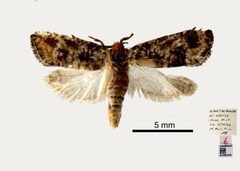
The specific epithet "pallipennis" (meaning "pale-winged") suggests pale coloration of the wings, which may distinguish it from with darker or more patterned wings. As a member of Retinia, it likely exhibits the characteristic tortricid resting posture with wings held roof-like over the body. Positive identification requires examination of genitalia or molecular analysis due to the morphological similarity among Retinia .
Images
Habitat
Based on -level associations, likely occurs in coniferous forests, particularly pine-dominated woodlands. The 45 iNaturalist observations suggest it is documented across its range in suitable forested .
Distribution
North America. The original description by McDunnough, a Canadian entomologist, and the basionym Petrova pallipennis suggest a North American distribution, though precise range boundaries are not well-documented in available sources.
Host Associations
- Pinus - probable Retinia are typically associated with Pinus species; specific records for R. pallipennis are not documented in available sources.
Similar Taxa
- Retinia resinellaBoth share the Retinia and similar conifer-associated ; R. resinella is a European with well-documented pine resin-feeding larvae, while R. pallipennis is North American and less studied.
- Retinia frustranaAnother North American Retinia associated with pines; morphological similarity requires careful examination to distinguish, particularly of wing pattern and genitalia.
More Details
Nomenclatural history
Originally described in the Petrova as Petrova pallipennis by McDunnough in 1938, this was later transferred to Retinia. The genus Petrova is now considered a synonym of Retinia by most authorities, though some historical literature may still reference this species under its original combination.
Data deficiency
Despite 45 iNaturalist observations, this lacks a Wikipedia entry and published biological accounts. Most available information is taxonomic rather than ecological, reflecting a common pattern for many non-pest tortricid species.