
Gypsonoma aceriana
(Duponchel, 1842)
poplar shoot-borer, Rosy Cloaked Shoot
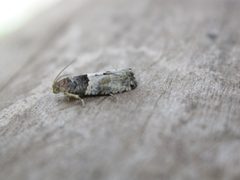
Gypsonoma aceriana is a small tortricid whose larvae bore into poplar and maple shoots, causing economic damage in plantations and nurseries. Native to Europe, it ranges eastward through Russia to Turkey, Iraq, and North Africa. The has been introduced to Japan, where it exhibits two to three annually. It is a significant pest of ornamental poplars, with older larvae destroying terminal shoots and causing bushy, unmarketable growth in young trees.
Pronunciation
How to pronounce Gypsonoma aceriana: /dʒɪp.səˈnoʊ.mə əˌsɛr.iˈɑːnə/
These audio files are automatically generated. While they are not always 100% accurate, they are a good starting point.
Identification
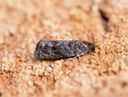
Distinguished from similar Gypsonoma by the combination of ochreous-whitish forewings with pale brownish suffusion posteriorly, the obtusely angulated edge of the fuscous basal patch, and the ill-defined, dorsally interrupted central fascia with a small blackish discal mark. The specific association with poplar and maple aids identification where host data are available. The grey hindwings contrast with the patterned forewings.
Images
Habitat
Poplar plantations and nurseries; ornamental poplar trees in urban areas. Associated with stands of Populus nigra, P. nigra subsp. italica, P. alba, and P. balsamifera, as well as maple Acer platanoides and A. campestre.
Distribution
Europe through Russia, extending to eastern Turkey, Iraq, and North Africa. Introduced to Japan. Recorded from Belgium, Bulgaria (Sofia, Svoge, Vardim, Pazardzhik), France, Germany, Italy, and the Netherlands.
Seasonality
active in July in native range. In Japan, two to three occur with adult in June, July, and August.
Diet
Larvae feed internally on Populus nigra, Populus nigra subsp. italica, Populus alba, Populus balsamifera, Acer platanoides, and Acer campestre. Older larvae (third instars) bore into buds and below terminal shoots.
Host Associations
- Populus nigra - larval food plantprimary
- Populus nigra subsp. italica - larval food plantprimary
- Populus alba - larval food plantprimary
- Populus balsamifera - larval food plantprimary
- Acer platanoides - larval food plantsecondary
- Acer campestre - larval food plantsecondary
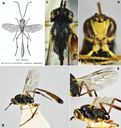
- Bracon variator - ectoparasitic, attacks young larvae
- Orgilus obscurator - endoparasitic
- Microdus tumidulus - endoparasitic, (41.0% of )
- Apanteles erevanicus - endoparasitic, (30.6% of )
- Pristomerus rufiabdominalis - endoparasitic
- Pristomerus vulnerator - endoparasitic
- Bassus tumidulus - solitary internal , attacks first–second instars, two
Life Cycle
Complete with larval development inside plant shoots. Larvae progress through at least three instars; older larvae (third instars) bore into buds and subterminal shoot tissue. stage not explicitly documented in sources. In Japan, two to three per year occur.
Behavior
Larvae are shoot-borers that destroy terminal shoots, inducing bushy lateral growth. is synchronized with emergence; Bassus tumidulus shows relatively good synchrony with first larval but poorer synchrony with second generation.
Ecological Role
Herbivore that damages poplar and maple shoots. Serves as for diverse larval complex (Braconidae and Ichneumonidae) that provides natural , with rates reaching 5.9–61.5% across .
Human Relevance
Economic pest of poplar plantations and nurseries in Europe, causing unmarketable growth in young trees through terminal shoot destruction. Recorded as a pest from Italy, France, Germany, and the Netherlands. Subject to research focusing on .
Similar Taxa
- Gypsonoma dealbanaSimilar size and wing pattern, but G. aceriana distinguished by association with poplar and maple, and specific forewing pattern elements including the obtusely angulated basal patch edge
- Gypsonoma minutanaOverlapping distribution and ; G. aceriana differs in forewing coloration (ochreous-whitish with brownish suffusion versus more uniform greyish tones in some ) and confirmed plant range
More Details
Parasitoid impact
Microdus tumidulus and Apanteles erevanicus are the most effective for , together accounting for over 70% of in Bulgarian . Bassus tumidulus causes 15.7–23.3% average mortality across , with peaks up to 61.5%.
Synchronization issues
Second- Bassus tumidulus often emerge before peak second-generation larval availability, potentially limiting control efficacy in later season.
Sources and further reading
- BugGuide
- Wikipedia
- GBIF taxonomy match
- iNaturalist taxon
- NCBI Taxonomy
- Catalogue of Life
- Species composition, structure and impact of larval parasitoids of poplar twig borer,Gypsonoma aceriana (Dup.) (Lepidoptera, Tortricidae), on poplar ornamental trees in Sofia
- Bioecological characteristics of Bassus tumidulus (Nees) (Hym., Braconidae), a parasitoid of the poplar twig borer, Gypsonoma aceriana (Dup.) (Lep., Tortricidae) in Bulgaria