
Epinotia nanana
(Treitschke, 1835)
European spruce needleminer, green spruce leaf miner, green spruce needle miner
Epinotia nanana is a small tortricid whose larvae are specialized needle miners of spruce trees. Native to Europe and Asia, it has been introduced to North America where it has become a pest of ornamental and forest spruce. The has a with larvae in mined needles and completing development the following spring. Larval feeding creates distinctive silken webbing that secures mined needles to twigs.
Pronunciation
How to pronounce Epinotia nanana: /ˌɛpɪˈnoʊʃə nəˈnænə/
These audio files are automatically generated. While they are not always 100% accurate, they are a good starting point.
Identification
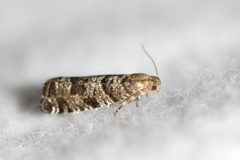
Distinguished from similar tortricids by the combination of small size (9–11 mm wingspan), fuscous forewings with distinctive whitish sprinkling and strigulated , and the obtusely angulated basal patch edge. Larval damage is diagnostic: spruce needles mined and webbed together with silk to form a cluster attached to the twig. Similar Epinotia may occur on spruce but differ in wing pattern details and larval webbing .
Images
Appearance
are small with wingspan 9–11 mm. pale brownish-ochreous with whitish . Forewings with gently arched ; ground color lighter or darker fuscous, whitish-sprinkled; costa strigulated with dark fuscous and white; basal patch edge obtusely angulated below middle; central fascia with projection; transverse streak before apex; markings dark fuscous. Hindwings rather dark fuscous. Full-grown larvae approximately 9 mm long, brown with black head and plate of second thoracic segment.
Habitat
Spruce forests and plantations; ornamental spruce plantings in urban and suburban settings. Larvae occur within the needles of trees. In Europe, primarily associated with Norway spruce (Picea abies) in natural and planted stands.
Distribution
Native to northern and central Europe, extending eastward through Russia to Mongolia. Introduced to North America: recorded from British Columbia, Ontario, and Quebec in Canada; and from Maine to Michigan and Ohio in the United States. Within its range, larvae show contagious (aggregated) distribution patterns both among trees and within shoots of individual trees.
Seasonality
on wing from June to August. Larvae active in needles during summer and fall, overwinter in mined needles, resume feeding in early spring, and pupate in May or June.
Diet
Larvae feed internally within spruce needles, mining the mesophyll. Documented include Norway spruce (Picea abies), Picea excelsa, blue spruce (Picea pungens), and Sitka spruce (Picea sitchensis). Norway spruce is preferred.
Host Associations
- Picea abies - primary preferred ; Norway spruce
- Picea excelsa -
- Picea pungens - blue spruce
- Picea sitchensis - Sitka spruce
Life Cycle
(one-year ). laid singly or occasionally in clusters on needles produced in previous year. Larvae hatch and feed within needles during summer and fall, mining the internal tissue. Nearly full-grown larvae (primarily fifth instar) overwinter in mined needles. In early spring, larvae resume feeding in adjacent needles, each larva mining 6–10 needles and securing them to the twig with silk. Full-grown larvae pupate in silken cocoons in soil litter or occasionally on the tree in May or June. Pupae develop into in approximately four weeks.
Behavior
Larvae are endophagous needle miners, feeding entirely within spruce needles. Each larva constructs silk webbing to bind 6–10 mined needles together and attach the cluster to the twig. This webbing is distinctive and protects the larva while feeding. Larvae show contagious spatial distribution, aggregating on certain shoots and trees rather than distributing randomly. larvae experience substantial mortality from unfavorable climatic conditions.
Ecological Role
Herbivore and pest of spruce trees. As a needle miner, it damages photosynthetic tissue and can cause severe defoliation of ornamental trees. Natural control is consistently low; appears driven primarily by (winter mortality) rather than biotic enemies. In its introduced North American range, it functions as an pest of non-native spruce plantings.
Human Relevance
Significant pest of ornamental spruce trees in urban and suburban landscapes, particularly in Quebec where severe defoliation has been recorded. Also occurs in forest spruce plantations. Damage is most conspicuous in spring when overwintered larvae resume feeding. Management is complicated by the protected feeding habit (larvae inside needles) and low natural .
Similar Taxa
- Other Epinotia species on spruceSimilar size and association; distinguished by wing pattern details, particularly the configuration of the basal patch and central fascia, and by larval webbing
- Other spruce needle-mining tortricidsSimilar larval habits; E. nanana distinguished by the characteristic webbing of multiple needles together and the specific wing pattern of
Sources and further reading
- BugGuide
- Wikipedia
- GBIF taxonomy match
- iNaturalist taxon
- NCBI Taxonomy
- Catalogue of Life
- My Publications | Beetles In The Bush
- Life History and Habits of the Green Spruce Leaf Miner, Epinotia nanana (Treitschke) (Lepidoptera: Tortricidae)
- Distribution of the Green Spruce Needle Miner Epinotia nanana Treitschke (Lepidoptera: Tortricidae) within and between Trees at Redesdale, Northumberland