
Ancylis discigerana
(Walker, 1863)
Yellow Birch Leaffolder Moth, Birch Leaffolder
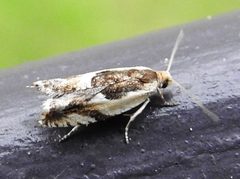
Ancylis discigerana is a small tortricid specialized on yellow birch (Betula alleghaniensis). The completes one annually, with larvae that fold leaves to feed within protected shelters. It is restricted to northeastern North America where its tree occurs.
Pronunciation
How to pronounce Ancylis discigerana: /ˈæŋsɪlɪs dɪsɪˈdʒɛrəna/
These audio files are automatically generated. While they are not always 100% accurate, they are a good starting point.
Identification
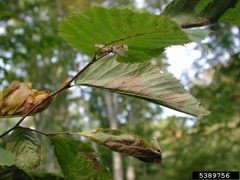
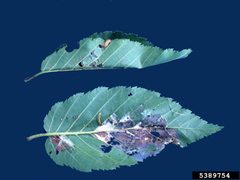
Distinguished from other Ancylis on yellow birch by combination of: with in early June; larvae that fold leaves longitudinally beginning at third instar; and specific larval feeding pattern (first-second instars skeletonize lower leaf surface beneath silk webbing between , third instar feeds on upper within folded leaf). A key for three Ancylis species on yellow birch has been published.
Images
Habitat
Forests dominated by or containing yellow birch (Betula alleghaniensis). Larval microhabitat includes leaf surfaces and leaf litter where final instars overwinter.
Distribution
Northeastern North America. Documented from Canada (Alberta, Manitoba) and United States (Vermont).
Seasonality
. active in early June. Larvae present from hatch through leaf fall, with final instar . occurs mid-April to mid-May.
Diet
Specialized feeder on yellow birch (Betula alleghaniensis). First and second instar larvae skeletonize lower leaf surfaces beneath silk webbing. Third instar larvae feed on upper leaf within longitudinally folded leaves.
Host Associations
- Betula alleghaniensis - obligate larval Yellow birch; sole documented . Larvae feed on leaves, with distinct feeding by instar.
Life Cycle
Complete with one per year. Final instar larvae overwinter in leaf litter. mid-April through mid-May. early June. Females deposit single on upper leaf surfaces, usually on major or slight epidermal depressions. Larvae pass through three instars: first-second instars feed concealed on lower leaf surface beneath silk webbing between lateral veins; third instar relocates to upper surface of new leaf, folds it lengthwise, and feeds within fold until leaf fall.
Behavior
Larval leaf-folding begins at third instar: larvae fold leaves longitudinally and feed within the protected shelter. Earlier instars construct silk webbing between two lateral on lower leaf surfaces, beneath which they skeletonize the leaf tissue.
Ecological Role
Herbivore on yellow birch foliage. Prey for at least two documented : parasitoid Trichogramma minutum and larval parasitoid Apanteles polychrosidis.
Similar Taxa
- Other Ancylis species on yellow birchAncylis includes multiple associated with yellow birch; A. discigerana distinguished by specific larval feeding (leaf-folding at third instar, earlier instars skeletonizing lower surface) and with early June .
More Details
Natural enemies
Two major documented in Canadian : Trichogramma minutum ( parasitoid) and Apanteles polychrosidis (larval parasitoid).