
Dioryctria resinosella
Mutuura, 1982
red pine shoot moth
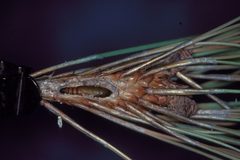
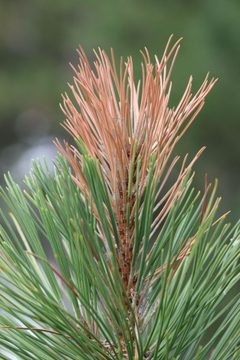
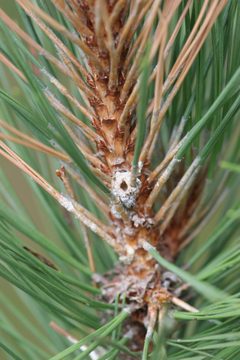
Dioryctria resinosella is a conifer-feeding in the Pyralidae, described in 1982. The larvae are specialized shoot borers of red pine (Pinus resinosa), attacking new shoots and cones. This exhibits localized patterns within plantations and has a with discrete seasonal activity. It is known from Ontario and the northern United States, with detailed bionomics studied in Wisconsin sand plain plantations.
Pronunciation
How to pronounce Dioryctria resinosella: /ˌdaɪ.ɔːˈrɪk.tri.ə ˌrɛ.zɪˈnoʊ.sɛl.lə/
These audio files are automatically generated. While they are not always 100% accurate, they are a good starting point.
Images
Habitat
Red pine (Pinus resinosa) plantations, particularly in sandy soils. In mixed pine stands, attacks are restricted to P. resinosa. rates are highest at plantation edges, in the upper half of the crown, and in stands greater than 20 years of age.
Distribution
Ontario, Canada and the northern United States. Documented in Wisconsin sand plain plantations; specific distribution within the northern U.S. not fully detailed in available sources.
Seasonality
period extends from mid-July to mid-September. Shoot feeding is initiated by third-instar larvae in late May. First-instar larvae overwinter in . occurs in July.
Diet
Larvae feed on new shoots and cones of red pine (Pinus resinosa).
Host Associations
- Pinus resinosa - primary larvae feed on shoots and cones; exclusive in mixed pine stands
- Hyssopus rhyacioniae - most frequently reared from larvae and pupae
Life Cycle
Five larval instars based on -capsule measurements. First-instar larvae overwinter in . Third-instar larvae initiate shoot feeding in late May. occurs in July. emerge with period from mid-July to mid-September. Sex ratio is 0.53 (female-biased).
Behavior
Larvae bore into new shoots and cones. Shoot attack begins in late May. is localized: highest rates occur at plantation edges, in the upper crown half, and in older plantations. In mixed stands, larvae exclusively select P. resinosa despite presence of other pine .
Ecological Role
Herbivore and pest of red pine plantations. Subject to natural by , particularly Hyssopus rhyacioniae.
Human Relevance
Economic pest of red pine in plantation forestry. Damage patterns suggest management implications for plantation design and age structure. Potential for using associated .
Similar Taxa
- Dioryctria auranticellaalso a coneworm in the same ; D. resinosella distinguished by specificity on Pinus resinosa and shoot-boring in addition to cone feeding
- Dioryctria abietellacongeneric coneworm ; D. resinosella differs in association (P. resinosa vs. various conifers) and geographic range
- Dioryctria pryericongeneric pest of pines; D. resinosella distinguished by description date (1982), specificity, and northern distribution
Sources and further reading
- BugGuide
- Wikipedia
- GBIF taxonomy match
- iNaturalist taxon
- NCBI Taxonomy
- Catalogue of Life
- Baryscapus dioryctriae Archives - Entomology Today
- Baryscapus dioryctriae - Entomology Today
- Bug Eric: New Mexico Night Bugs
- Bug Eric: My Personal National Moth Week, 2017
- Bug Eric: September 2017
- New Wasp Species Discovered Parasitizing Pests of Pine Trees
- BIONOMICS AND PATTERN OF ATTACK OF THE RED PINE SHOOT MOTH, DIORYCTRIA RESINOSELLA (LEPIDOPTERA: PYRALIDAE), IN WISCONSIN