
Dioryctria pseudotsugella
Munroe, 1959
Douglas-fir coneworm moth
A small coneworm in the Pyralidae, described by Eugene G. Munroe in 1959. The is associated with coniferous forests across western North America, where its larvae develop in the cones and cambium of Douglas-fir and related trees. The specific epithet references its primary host Pseudotsuga.
Pronunciation
How to pronounce Dioryctria pseudotsugella: /daɪ.ɔːˈrɪk.tri.ə ˌsjuː.doʊtˈsuːɡɛl.ə/
These audio files are automatically generated. While they are not always 100% accurate, they are a good starting point.
Identification
The small size (10–11 mm wingspan) distinguishes from larger coneworm . Within the Dioryctria, precise identification to species level typically requires examination of genitalia or larval association. The species name and geographic occurrence in the Douglas-fir region of western North America provide contextual clues. Similar coneworm species in the same genus overlap in range and require dissection for definitive separation.
Images
Appearance
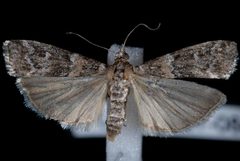
have a wingspan of 10–11 mm. As a member of the Dioryctria, adults likely exhibit the typical coneworm : relatively slender body with wings often held in a tent-like or slightly flattened posture at rest. Specific coloration and pattern details for this are not documented in available sources.
Habitat
Coniferous forest dominated by Douglas-fir and related conifer . The encompasses mature forest stands where trees produce cones and have intact cambium layers suitable for larval development.
Distribution
Western North America from southern British Columbia and Alberta southward to New Mexico. The range corresponds closely with the distribution of its primary tree, Douglas-fir (Pseudotsuga menziesii).
Diet
Larvae feed primarily on the cones and cambium of conifers, with occasional feeding on needles. Documented host plants include Pseudotsuga menziesii (Douglas-fir), Picea (spruces), Abies (firs), and Tsuga (hemlocks).
Host Associations
- Pseudotsuga menziesii - larval primary ; cones and cambium
- Picea - larval cones and cambium
- Abies - larval cones and cambium
- Tsuga - larval cones and cambium
Life Cycle
Complete with , larva, pupa, and stages. Larvae develop within conifer cones and under bark, feeding on cambium tissue. Specific details of and stage are not documented.
Behavior
Larvae are concealed feeders, tunneling within cones and cambium of trees. This cryptic habit provides protection from and environmental extremes.
Ecological Role
As a primary consumer, larvae transfer energy from conifer tissues to higher . The concealed feeding habit makes them for specialized . They contribute to nutrient cycling in forest through their herbivory on reproductive structures and vascular tissues of conifers.
Human Relevance
Larvae may cause damage to conifer cones and cambium, potentially affecting seed production and tree health in forest stands. The is part of a containing significant forest pests, though specific economic impact of D. pseudotsugella is not quantified. Its , including related species in the genus Baryscapus, are subjects of research for coneworm management.
Similar Taxa
- Dioryctria abietellaOverlapping geographic range and conifer-feeding habit; requires genitalia examination for separation
- Dioryctria pryeriSimilar coneworm and ; distinguished by preferences and subtle morphological differences
- Dioryctria auranticellaAnother small coneworm in western North America with similar size; identification requires examination
More Details
Taxonomic History
Described by Canadian lepidopterist Eugene G. Munroe in 1959, a in Pyralidae . The epithet pseudotsugella directly references the Pseudotsuga, indicating early recognition of its close association with Douglas-fir.
Research Context
Members of the Dioryctria are increasingly studied for their role as forest pests and as targets for . The discovery of Baryscapus dioryctriae as a of related Dioryctria in China highlights the ecological importance of these and their natural enemies in conifer forest globally.
Sources and further reading
- BugGuide
- Wikipedia
- GBIF taxonomy match
- iNaturalist taxon
- NCBI Taxonomy
- Catalogue of Life
- Baryscapus dioryctriae Archives - Entomology Today
- Baryscapus dioryctriae - Entomology Today
- Bug Eric: New Mexico Night Bugs
- Bug Eric: My Personal National Moth Week, 2017
- Bug Eric: September 2017
- New Wasp Species Discovered Parasitizing Pests of Pine Trees