
Acrobasis demotella
Grote, 1881
Walnut Shoot Moth
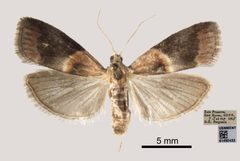
Acrobasis demotella, the walnut shoot , is a small pyralid moth described by Grote in 1881. Its larvae feed on Juglans (walnut) and Carya (hickory/pecan) , making it a pest of nut-producing trees. The species occurs across eastern and central North America. It is one of several Acrobasis species associated with hardwood trees in the walnut .
Pronunciation
How to pronounce Acrobasis demotella: //ˌækrəˈbeɪsɪs ˌdɛmoʊˈtɛlə//
These audio files are automatically generated. While they are not always 100% accurate, they are a good starting point.
Identification
The can be distinguished from related Acrobasis by association with its specific plants (Juglans and Carya species) and geographic range. Acrobasis nuxvorella (pecan nut casebearer), a closely related pest species, has a distinctive ridge of dark across the forewings and is primarily associated with pecan in the southern United States. Acrobasis demotella has a more northerly distribution and broader host range including walnuts. Definitive identification may require dissection or molecular analysis.
Images
Appearance
have a wingspan of 20–24 mm. As a member of the Phycitinae , it likely has relatively narrow forewings with characteristic patterning typical of the group, though specific coloration details are not well documented in available sources.
Habitat
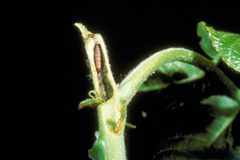
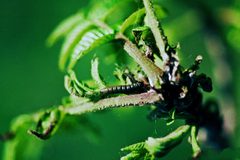
Found in deciduous forests and woodlands, as well as orchards and cultivated areas where trees (walnut, hickory, pecan) are present. The larval stage occurs within shoots and nut clusters of host trees.
Distribution
North America, from Ontario south to North Carolina and west to Missouri and Michigan. Records also include Vermont.
Diet
Larvae feed on Juglans (walnuts), Carya illinoinensis (pecan), and other Carya species (hickories). The specific feeding habits within these (shoot boring, nut feeding, etc.) are not explicitly documented for this species, though related Acrobasis species are shoot borers or nut feeders.
Host Associations
- Juglans - larval food plantwalnut
- Carya illinoinensis - larval food plantpecan
- Carya - larval food planthickory
Ecological Role
As a herbivore of Juglandaceae, the larvae function as primary consumers. The serves as a for , including ichneumonids in the Mesostenus, which are known to parasitize Acrobasis caterpillars.
Human Relevance
Economic impact on walnut and hickory/pecan through larval feeding damage. Less intensively studied than the related pecan nut casebearer (A. nuxvorella), which is a major pecan pest. Management approaches likely similar to other Acrobasis shoot borers, involving monitoring and targeted applications.
Similar Taxa
- Acrobasis nuxvorellaAlso feeds on Carya illinoinensis; distinguished by more southerly distribution, association primarily with pecan orchards, and distinctive forewing ridge
- Acrobasis juglandisAnother walnut-feeding Acrobasis ; specific differences in preference and require examination
- Acrobasis betulellaRelated in same with different associations (Betula, birch)
More Details
Parasitoid associations
The Acrobasis, including A. demotella, is documented as a for in the genus Mesostenus (Ichneumonidae). Mesostenus use their long ovipositors to attack concealed caterpillars such as shoot-boring Acrobasis larvae.
Taxonomic note
The was described by Augustus Radcliffe Grote in 1881, a prominent 19th-century American lepidopterist.
Sources and further reading
- BugGuide
- Wikipedia
- GBIF taxonomy match
- iNaturalist taxon
- NCBI Taxonomy
- Catalogue of Life
- Acrobasis nuxvorell Archives - Entomology Today
- Pecan Nut Casebearer: New Guide Provides IPM Options
- Bug Eric: Wasp Wednesday: Mesostenus
- Bug Eric: A Potential New Host Record for Calliephialtes grapholithae (Hymenoptera: Ichneumonidae) from a Paper Wasp nest (Hymenoptera: Vespidae: Polistes metricus)