
Acrobasis angusella
Grote, 1880
Hickory Leafstem Borer, Leafstem Borer, Hickory Leafstem Borer Moth
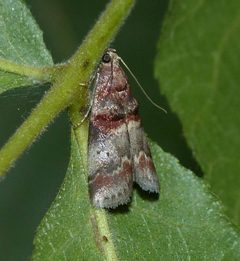
Acrobasis angusella, described by Grote in 1880, is a snout moth in the Pyralidae. The is known from Quebec, Canada, and the northeastern United States. have a wingspan of approximately 18 mm and are active from May through September. The larvae are specialized feeders on hickory species (Carya), boring into leaf stems and causing premature leaf drop.
Pronunciation
How to pronounce Acrobasis angusella: /ˌækrəˈbeɪsɪs ˌæŋɡjuːˈsɛlə/
These audio files are automatically generated. While they are not always 100% accurate, they are a good starting point.
Identification
Distinguished from other Acrobasis by association with hickory (Carya) and the specific habit of boring in leaf stems rather than nuts or shoots. Acrobasis nuxvorella (pecan nut casebearer) attacks pecan nuts and has a distinctive ridge of dark across the forewings. Acrobasis juglandis and A. betulella are associated with walnut and birch respectively. Definitive identification may require examination of genitalia or molecular analysis.
Images
Habitat
Deciduous forests and woodlands where hickory (Carya) occur. Also found in suburban and rural areas with hickory trees. The species is closely tied to the presence of its plants.
Distribution
Known from Quebec, Canada, and the northeastern United States. Distribution records include Vermont. The range corresponds to that of its primary hickory .
Seasonality
are on wing from May to September. The extended period suggests multiple or a prolonged pattern, though specific voltinism is not documented.
Diet
Larvae feed exclusively on Carya , including Carya glabra (pignut hickory), Carya ovalis (red hickory), and Carya tomentosa (mockernut hickory). Larvae bore into the leaf stems (petioles) of plants. feeding habits are not documented.
Host Associations
- Carya glabra - larval pignut hickory
- Carya ovalis - larval red hickory
- Carya tomentosa - larval mockernut hickory
Life Cycle
Complete with , larva, pupa, and stages. Larvae bore into leaf stems of hickory, causing leaves to fall prematurely. likely occurs in soil or leaf litter, though this is not explicitly documented. Specific details on egg placement, number of , and stage are not available.
Behavior
Larvae are stem borers, tunneling within hickory leaf petioles. This feeding results in leaf abscission. The mechanism by which larvae induce leaf drop is not described in detail.
Ecological Role
As a herbivore on hickory, the contributes to leaf turnover in forest . The premature leaf drop caused by larval feeding may affect photosynthetic capacity of trees, though the ecological impact is likely minor on healthy trees. The species serves as host for , including potential association with Mesostenus species (Ichneumonidae).
Human Relevance
Considered a minor pest of hickory. The leaf drop caused by larval feeding can be conspicuous but is generally not economically significant. No specific management recommendations are documented. The is not known to be a target of programs.
Similar Taxa
- Acrobasis nuxvorellaAlso in Acrobasis, but attacks pecan nuts rather than leaf stems; has distinctive ridge of dark on forewings; economically significant pecan pest
- Acrobasis juglandisAssociated with walnut (Juglans) rather than hickory; different specificity
- Acrobasis betulellaAssociated with birch (Betula); different plant
More Details
Parasitoid associations
The Acrobasis, including A. angusella, is known to be parasitized by ichneumonid wasps in the genus Mesostenus, which use their long ovipositors to attack stem-boring caterpillars. Specific records for A. angusella are not documented but are plausible given the of related .
Taxonomic history
Described by Augustus Radcliffe Grote in 1880, a prominent 19th-century American entomologist who described numerous Lepidoptera .
Sources and further reading
- BugGuide
- Wikipedia
- GBIF taxonomy match
- iNaturalist taxon
- NCBI Taxonomy
- Catalogue of Life
- Acrobasis nuxvorell Archives - Entomology Today
- Pecan Nut Casebearer: New Guide Provides IPM Options
- Bug Eric: Wasp Wednesday: Mesostenus
- Bug Eric: A Potential New Host Record for Calliephialtes grapholithae (Hymenoptera: Ichneumonidae) from a Paper Wasp nest (Hymenoptera: Vespidae: Polistes metricus)