
Nomophila nearctica
Munroe, 1973
Lucerne Moth, Clover Nomophila, False Webworm, Celery Stalkworm, American Celery Webworm
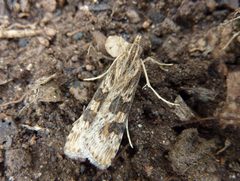
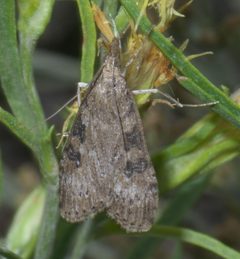
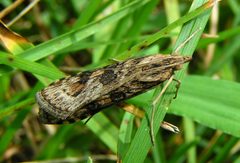
Nomophila nearctica is a crambid with broad distribution across North America and southward into the Neotropics. are active from spring through late autumn. The is notable for its narrow, elongated wing profile and association with low-growing herbaceous vegetation. Larvae feed on a range of plants including grasses, legumes, and celery, making it occasionally significant in agricultural contexts.
Pronunciation
How to pronounce Nomophila nearctica: //nɔˈmoʊfɪlə nɪˈɑrktɪkə//
These audio files are automatically generated. While they are not always 100% accurate, they are a good starting point.
Identification
The narrow, elongated wing shape is the most reliable field characteristic. When at rest, the presents a slender, almost stick-like profile unlike the broader-winged appearance of most related crambids. are attracted to light and can be found at sheet setups during warmer months.
Images
Habitat
Open with low-growing vegetation, including grasslands, meadows, agricultural fields, gardens, and disturbed areas. Associated with herbaceous plants rather than woody vegetation.
Distribution
Southern Canada through all of the United States, continuing south to Mexico and the Neotropics. More northerly in western North America compared to eastern regions.
Seasonality
are on wing from April to November in North America, with peak activity during warmer months. Multiple likely occur within this extended period.
Diet
Larvae feed on celery (Apium graveolens), various grasses, lucerne/alfalfa (Medicago sativa), sweet clover (Melilotus), knotweed (Polygonum), and other low-growing herbaceous plants. feeding habits are not documented in available sources.
Life Cycle
Complete with , larval, pupal, and stages. Larvae are associated with herbaceous plants. Specific details of site and number of per year are not documented in available sources.
Behavior
are and attracted to artificial light sources. Larvae feed on low-growing plants and have been documented as occasional pests in celery .
Ecological Role
Larval herbivore in grassland and agricultural . Contributes to nutrient cycling through consumption of herbaceous vegetation. Serves as prey for various including birds, bats, and insects.
Human Relevance
Known as a minor agricultural pest, particularly in celery production where larval feeding on stalks causes direct damage. Also referred to as "celery stalkworm" and "American celery webworm" in agricultural literature. The "lucerne " reflects its association with alfalfa .
Similar Taxa
- Nomophila noctuellaSimilar narrow-winged and shared , but N. noctuella is primarily Palearctic and known for long-distance in Europe, whereas N. nearctica is to the Americas with different distribution pattern.
- Other CrambidaeMost crambid have broader, more triangular forewings and stockier body proportions; the exceptionally slender wing shape of Nomophila is distinctive within the .
Sources and further reading
- BugGuide
- Wikipedia
- GBIF taxonomy match
- iNaturalist taxon
- NCBI Taxonomy
- Catalogue of Life
- Bug Eric: First Night of Blacklighting
- Bug Eric: April 2024
- Insect Migration (Part 1) - Buglife Blog - Buglife
- Mudo Pryfed (Rhan 1) - Buglife Blog - Buglife
- Bug Eric: Missing Sector Orbweaver, Zygiella x-notata
- Bug Eric: February 2009