
Glyphodes pyloalis
Walker, 1859
lesser mulberry snout moth, lesser mulberry pyralid, beautiful glyphodes moth, mulberry pyralid
Glyphodes pyloalis is a small crambid native to Asia that has expanded its range to North America, Africa, and Central Asia. It is a pest of mulberry (Morus spp.), with larvae feeding on leaves and causing significant economic damage to and mulberry . The has shown notable range expansion in recent decades, facilitated by climate warming and wind . are strongly influenced by temperature extremes, with cold winters causing mass mortality of larvae.
Pronunciation
How to pronounce Glyphodes pyloalis: //ˈɡlɪfoʊdiːz ˌpaɪloʊˈeɪlɪs//
These audio files are automatically generated. While they are not always 100% accurate, they are a good starting point.
Identification
Distinguished from other Glyphodes by association with mulberry and confirmed by genitalia examination or molecular identification. The 'lesser mulberry snout ' reflects its smaller size compared to related mulberry-feeding species. In North America, identification should be confirmed by dissection or due to presence of similar native and introduced crambid species.
Images
Appearance
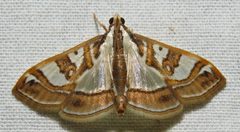
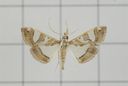
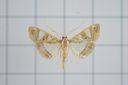
Small with wingspan approximately 20 mm. have characteristic crambid with elongated labial palps forming a snout-like projection. Wing patterns and coloration typical of Glyphodes , though specific markings require specimen examination.
Habitat
Primarily associated with mulberry systems, including commercial plantations, field edge trees, and urban plantings of Morus spp. In Central Asia, occupies agroecosystems in valley systems with irrigated mulberry. larvae occur in sheltered locations on or near plants.
Distribution
Native to East and Southeast Asia: China, Japan, Korea, India, Indonesia (Sumatra), Sri Lanka, Taiwan, Nepal, Pakistan, Malaysia. Expanded range includes: Iran, Afghanistan, Central Asian republics (Uzbekistan since 1993, Tajikistan, Turkmenistan, Kyrgyzstan), Azerbaijan, Georgia, Russia; Africa (Democratic Republic of the Congo, Equatorial Guinea, Mozambique, Liberia, Mali); North America (USA: Florida, Maryland, North Carolina, South Carolina, Virginia, Mississippi; Mexico). First recorded in Turkey (Yalova) in 2018.
Seasonality
Multiple per year in favorable climates. active during warmer months. occurs as larvae. In Fergana Valley, fluctuations linked to seasonal conditions: sharp cold spells in winter (noted 2002, 2008, 2014) and spring (2015, 2021) cause population declines in subsequent seasons. Summer drought and extreme heat (2022) also limit development.
Diet
feeder on mulberry (Morus spp.). Larvae consume leaves of white mulberry (Morus alba), black mulberry (Morus nigra), and weeping white mulberry (Morus alba cv. 'Pendula'). Laboratory studies show variation in nutritional across mulberry cultivars (Kenmochi, Ichinose, Shin Ichinose, Mahalii), with Shin Ichinose supporting highest conversion efficiency and Kenmochi being least suitable.
Host Associations
- Morus alba - larval white mulberry, primary in
- Morus nigra - larval black mulberry
- Morus alba cv. 'Pendula' - larval weeping white mulberry
Life Cycle
Holometabolous with four stages: , larva, pupa, . Overwinters as larva. Developmental duration and survival rates quantified in laboratory studies on mulberry. Fifth instar larvae show highest feeding on certain mulberry cultivars. Specific timing of varies with latitude and climate.
Behavior
Females exhibit calling to attract males, with mean mating time preceding mean calling time by 3.5–5 hours on days 2–4 after . Males do not perform stereotyped mating dance when females call. Males strongly attracted to virgin females and to abdominal tip extracts of virgin females (88% attraction in field-cage tests to virgin females, 40% to crude extract). Range expansion facilitated by wind ('Afghan winds' in Central Asia).
Ecological Role
Pest of mulberry agroecosystems. Damage levels can reach 25–50% or higher in years, causing defoliation and economic losses to and fruit production. No significant documented role as or prey , though presumably consumed by and .
Human Relevance
Major economic pest of mulberry worldwide. Threatens (silk production) through defoliation of mulberry, the sole food plant of . Newly detected in Turkey in 2018, prompting monitoring and management concerns. Subject of research including (Artemisia annua ), silica nanoparticles, and -based monitoring. No chemical inputs traditionally used in Turkish mulberry production, increasing vulnerability to establishment.
Similar Taxa
- Glyphodes sibillalissimilar and , distinguished by association and genitalia
- Other Crambidae in Spilomelinaemany small crambid with snout-like palps require dissection or for identification
More Details
Climate Change Response
strongly correlated with temperature changes. +1.1°C warming in 2001–2022 compared to 1971–2000 baseline correlated with trends (r=0.7 for July temperatures). Cold winters with high humidity cause mass mortality of larvae; extreme heat and drought limit summer development.
Pheromone Research
identified and used in . Potential for monitoring and in programs, though commercial deployment status unclear.
Host Plant Cultivar Effects
Digestive activity varies with mulberry cultivar: highest and amylase activity on Mahalii variety, lowest on Kenmochi. Trypsin and elastase activity highest on Mahalii. These physiological differences affect larval performance and may inform cultivar selection.
Sources and further reading
- BugGuide
- Wikipedia
- GBIF taxonomy match
- iNaturalist taxon
- NCBI Taxonomy
- Catalogue of Life
- Biology and demography of Glyphodes pyloalis Walker (Lepidoptera: Pyralidae) on mulberry
- Mating Behavior and the Sex Pheromone of the Lesser Mulberry Pyralid, Glyphodes pyloalis WALKER (Lepidoptera : Pyralidae)
- FEATURES OF THE DISTRIBUTION OF THE MULBERRY PYRALID (GLYPHODES PYLOALIS WALKER) UNDER GLOBAL CLIMATE CHANGE
- Biology, ecology, and innovative management strategies for Glyphodes pyloalis: Toward climate-smart and sustainable integrated pest management in mulberry production
- Mulberry Protection through Flowering-Stage Essential Oil of Artemisia annua against the Lesser Mulberry Pyralid, Glyphodes pyloalis Walker
- A pest that could be posing a threat to mulberry production of Turkey: Glyphodes pyloalis (Walker, 1859) (Lepidoptera: Crambidae)
- Crossing Experiments and the Behavioral Study of Two Types of the Mulberry Pyralid, Glyphodes pyloalis WALKER (Lepidoptera : Pyralidae)
- Effect of four varieties of mulberry on biochemistry and nutritional physiology of mulberry pyralid, Glyphodes pyloalis Walker (Lepidoptera: Pyralidae)
- Synthesis of silica nanoparticles from rice husk to determine insecticidal properties against Glyphodes pyloalis walker (Lepidoptera: Crambidae).