
Glyphodes
Guenée, 1854
mulberry pyralid moths
Species Guides
4- Glyphodes floridalis(Florida milkweed vine moth)
- Glyphodes onychinalis
- Glyphodes pyloalis(lesser mulberry snout moth)
- Glyphodes sibillalis(Mulberry Leaftier)
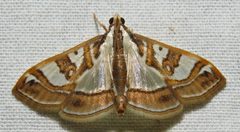
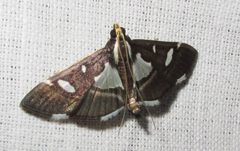
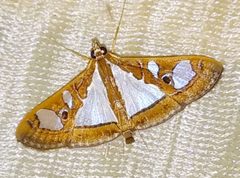
Glyphodes is a of in the Crambidae, Spilomelinae, described by Achille Guenée in 1854. The genus contains multiple distributed across tropical and subtropical regions, with some species having expanded their ranges significantly in recent decades. Several species are economically important as pests of cultivated plants, particularly mulberry (Morus spp.), jack-fruit (Artocarpus heterophyllus), and jasmine (Jasminum spp.). Glyphodes pyloalis, known as the lesser mulberry pyralid or mulberry pyralid, is the most extensively studied species due to its impact on and mulberry production globally.
Pronunciation
How to pronounce Glyphodes: //ˈɡlaɪfəˌdiːz//
These audio files are automatically generated. While they are not always 100% accurate, they are a good starting point.
Identification
within Glyphodes can be distinguished by and male genitalia characters. Glyphodes vertumnalis has entirely green body coloration. Glyphodes pulverulentalis displays oblique lateral stripes on the . Glyphodes caesalis shows a sub-marginal black-edged patch on the with four spots. In male genitalia, G. vertumnalis has a greatly curved, beak-shaped uncus; G. caesalis has a slim, slightly curved uncus; and G. pulverulentalis has a long, narrow, slightly curved uncus with short setae at the apex. Accurate species identification requires examination of genitalia morphology.
Images
Habitat
vary by but generally include agricultural and cultivated areas where plants are grown. Glyphodes pyloalis occurs in mulberry plantations, field edge plantings, and foothill to mid-mountain regions. In the Fergana Valley, it has been documented in mulberry plantations across Fergana, Andijan, and Namangan regions, including foothill areas such as Sokh and Shahimardan. Glyphodes species in Karnataka, India, are found in areas cultivating jack-fruit, mulberry, and jasmine.
Distribution
The has broad geographic distribution across tropical and subtropical regions. Glyphodes pyloalis is native to Southeast Asia (Japan, Korea, Malaysia, China, India, Nepal, Pakistan) and has been recorded in North America (Florida, Mississippi, Virginia in USA; Mexico), Azerbaijan, Georgia, and Russia. It expanded north through Afghanistan in the late 20th century, reached Central Asian republics (Tajikistan, Turkmenistan, Uzbekistan, Kyrgyzstan) and Iran by the late 1990s, with first detection in Uzbekistan (Surkhandarya) in 1993 and in the Fergana Valley in 1997. In Turkey, it was first detected in Yalova province in August 2018. Other have more restricted distributions: G. caesalis, G. pulverulentalis, and G. vertumnalis are documented from Karnataka, India. Glyphodes bivitralis has been recorded from Telangana, India.
Seasonality
Glyphodes pyloalis overwinters as larvae. In the Fergana Valley, sharp cold snaps in winter (2002, 2008, 2014) and spring (2015, 2021) caused significant declines. Summer drought and prolonged maximum temperatures, as observed in 2022, act as limiting factors on development rates.
Host Associations
- Morus (mulberry) - primary Documented for G. pyloalis and G. pulverulentalis. Includes Morus alba (white mulberry), Morus nigra (black mulberry), and Morus alba cv. 'Pendula' (weeping white mulberry).
- Artocarpus heterophyllus (jack-fruit) - primary Documented for G. caesalis in Karnataka, India.
- Jasminum spp. (jasmine) - primary Documented for G. vertumnalis in Karnataka, India.
Life Cycle
Complete with , larval, pupal, and stages. Glyphodes pyloalis overwinters as larvae. Larvae have been successfully reared to adulthood on respective plants under laboratory conditions for G. caesalis, G. pulverulentalis, and G. vertumnalis. Pupal including Brachymeria lasus and Xanthopimpla stemmator have been recorded attacking G. bivitralis pupae in Telangana, India.
Behavior
Glyphodes pyloalis exhibits fluctuations in response to seasonal ecological factors. Sharp cold snaps in winter and spring cause mass mortality of larvae and significant reduction in subsequent growing seasons. Drought and prolonged maximum summer temperatures act as limiting factors on development rates. Mating and communication have been documented in G. pyloalis. Two distinct types of G. pyloalis have been identified through crossing experiments and behavioral studies.
Ecological Role
Herbivore in agroecosystems. Several function as pests of economically important cultivated plants. Glyphodes pyloalis damage levels can reach 25–50% or higher in years, affecting industries dependent on mulberry leaves for rearing. The species serves as for pupal including Brachymeria lasus and Xanthopimpla stemmator.
Human Relevance
Significant agricultural pest, particularly G. pyloalis as the lesser mulberry pyralid. Causes serious damage to mulberry leaves used in , affecting silk production in Asia, Central Asia, and newly invaded areas such as Turkey. Management research includes testing of Artemisia annua (containing camphor, artemisia ketone, β-selinene, pinocarvone, 1,8-cineole, and α-pinene) and silica nanoparticles from rice husk as alternative . -based monitoring and management strategies have been investigated.
Similar Taxa
- Other Crambidae genera in SpilomelinaeSimilar general and use; distinguished by genitalia characters and associations. Glyphodes specifically associated with mulberry, jack-fruit, or jasmine may be confused with other pyralid pests of these crops, but male genitalia morphology provides definitive identification.
More Details
Climate change and range expansion
Glyphodes pyloalis has demonstrated significant range expansion correlated with climate change. Mean temperature in the Fergana Valley increased by 1.1°C between 2001–2022, with July temperatures showing significant rise (r=0.7, P>0.001). This warming has facilitated northward expansion from native Southeast Asian range through Afghanistan to Central Asia by the 1990s, with ongoing spread into new regions including Turkey in 2018.
Taxonomic note
The contains with varying associations, and not all species are mulberry . While G. pyloalis and G. pulverulentalis use mulberry, G. caesalis uses jack-fruit and G. vertumnalis uses jasmine, indicating diverse ecological specialization within the genus.
Sources and further reading
- BugGuide
- Wikipedia
- GBIF taxonomy match
- iNaturalist taxon
- NCBI Taxonomy
- Catalogue of Life
- Biology and demography of Glyphodes pyloalis Walker (Lepidoptera: Pyralidae) on mulberry
- Taxonomic studies on the genus Glyphodes Guenee (Lepidoptera: Crambidae: Spilomelinae) from Karnataka, India
- FEATURES OF THE DISTRIBUTION OF THE MULBERRY PYRALID (GLYPHODES PYLOALIS WALKER) UNDER GLOBAL CLIMATE CHANGE
- Biology, ecology, and innovative management strategies for Glyphodes pyloalis: Toward climate-smart and sustainable integrated pest management in mulberry production
- Mulberry Protection through Flowering-Stage Essential Oil of Artemisia annua against the Lesser Mulberry Pyralid, Glyphodes pyloalis Walker
- First report of pupal parasitoids Brachymerialasus (Walker) and Xanthopimpla stemmator (Thunberg) on Glyphodes bivitralis, Guenée (Crambidae: Lepidoptera) from Telangana, India
- Mating Behavior and the Sex Pheromone of the Lesser Mulberry Pyralid, Glyphodes pyloalis WALKER (Lepidoptera : Pyralidae)
- Crossing Experiments and the Behavioral Study of Two Types of the Mulberry Pyralid, Glyphodes pyloalis WALKER (Lepidoptera : Pyralidae)
- A pest that could be posing a threat to mulberry production of Turkey: Glyphodes pyloalis (Walker, 1859) (Lepidoptera: Crambidae)
- Synthesis of silica nanoparticles from rice husk to determine insecticidal properties against Glyphodes pyloalis walker (Lepidoptera: Crambidae).