
Diaphania infimalis
Guenée, 1854
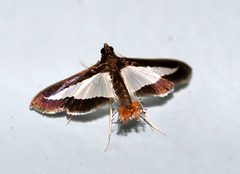
Diaphania infimalis is a small crambid described by Guenée in 1854. It occurs across the Caribbean, Central America, and northern South America, with a northern extension into Florida. Forewing length ranges 9–10 mm in males and 9–11 mm in females. Larvae have been documented feeding on Melothria grendula.
Pronunciation
How to pronounce Diaphania infimalis: /daɪˈæfəniə ɪnˈfɪməlɪs/
These audio files are automatically generated. While they are not always 100% accurate, they are a good starting point.
Identification
Differs from congeneric () and () by geographic distribution and subtle wing pattern differences; precise distinguishing characters require examination. The smaller size and more southerly Caribbean-Central American range may aid separation from North American Diaphania .
Images
Appearance
Habitat
Associated with plant Melothria grendula; likely occurs in tropical and subtropical environments where this plant grows. Specific preferences beyond host association remain undocumented.
Distribution
Florida (USA), Mexico, Guatemala, Belize, Bahamas, Cuba, Jamaica, Panama, Venezuela, and Bolivia.
Diet
Larvae feed on Melothria grendula (Cucurbitaceae). feeding habits are unknown.
Host Associations
- Melothria grendula - larval food plantOnly documented ; relationship established through larval feeding records
Similar Taxa
- Diaphania nitidalis is congeneric and occurs in overlapping regions; D. infimalis is smaller and has more restricted Caribbean-Central American distribution versus broader North American range of D. nitidalis
- Diaphania hyalinata is larger congeneric with similar translucent wing appearance; D. infimalis has smaller forewings and more southerly distribution
More Details
Taxonomic Note
GBIF lists this as a synonym under Cryptographis infimalis, indicating ongoing taxonomic uncertainty or recent reclassification proposals. The Diaphania placement follows current Wikipedia and iNaturalist usage.
Research Context
While congeneric D. nitidalis and D. hyalinata are well-studied agricultural pests of cucurbits, D. infimalis has received minimal research attention and lacks detailed biological studies beyond basic distribution and records.