
Pyrausta pseuderosnealis
Munroe, 1976
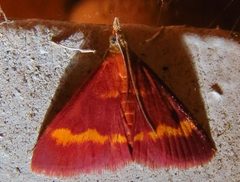
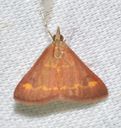
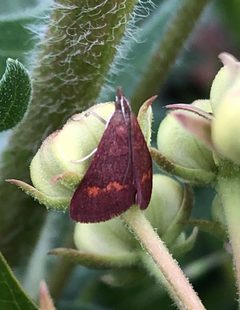
Yellow-banded Pyrausta Moth
Pyrausta pseuderosnealis is a small crambid described by Eugene G. Munroe in 1976. It occurs across much of the southern and central United States and Mexico. are active year-round in warmer regions, with records spanning January through October. The belongs to a containing several economically significant herbivores, though specific biological details for this species remain poorly documented.
Pronunciation
How to pronounce Pyrausta pseuderosnealis: /paɪˈraʊstə sjuːˌdɛroʊsˈniːəlɪs/
These audio files are automatically generated. While they are not always 100% accurate, they are a good starting point.
Identification
Distinguishing P. pseuderosnealis from other Pyrausta requires examination of genitalia or detailed wing pattern analysis. The species name suggests resemblance to P. erosnealis. are small (12–15 mm wingspan) and active across an unusually broad seasonal range. Geographic distribution may aid identification: present in California, Texas, Florida, and throughout the southeastern and midwestern United States.
Images
Appearance
Small with wingspan of 12–15 mm. As a member of Pyrausta, it likely exhibits the typical crambid moth form with elongated labial palps (snout-like projection from the ). Specific coloration and pattern details for this are not well documented in available sources.
Habitat
Associated with diverse environments across its broad North American range, from California to the southeastern coastal plain. Specific preferences are not documented.
Distribution
Mexico and the United States. Recorded from California, Texas, Florida, Alabama, Georgia, Iowa, Mississippi, South Carolina, Louisiana, Arkansas, Missouri, Illinois, and Oklahoma.
Seasonality
recorded on wing from January to October, indicating extended or multiple periods across its range. Activity likely varies by latitude, with year-round presence possible in southern regions and more restricted seasons in northern areas.
Similar Taxa
- Pyrausta erosnealisClosely related indicated by the specific epithet 'pseuderosnealis' (false erosnealis), suggesting morphological similarity requiring careful differentiation.
- Pyrausta signatalisAnother small Pyrausta with similar size and general appearance; the 'raspberry pyrausta' is a well-documented congeneric herbivore that may be confused with P. pseuderosnealis in eastern North America.
More Details
Taxonomic note
The was established by Canadian lepidopterist Eugene G. Munroe in 1976. Munroe was a leading authority on North American Pyraloidea, making his determinations highly reliable.
Data limitations
Despite being described nearly 50 years ago, P. pseuderosnealis remains poorly known biologically. Available sources provide only distributional and basic size data. The 1,358 iNaturalist observations suggest it is frequently encountered but not well studied.