
Loxostege albiceralis
Grote, 1878
Tan-edge Loxostege
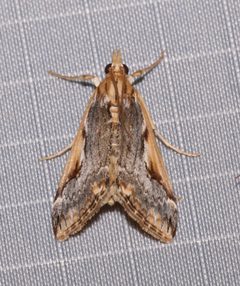
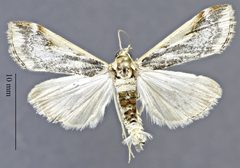
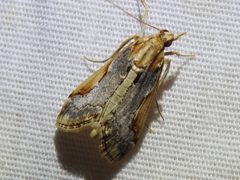
Loxostege albiceralis is a crambid described by Augustus Radcliffe Grote in 1878. It occurs in arid regions of the southwestern United States and northern Mexico. The is notable as a documented for the mason wasp Euodynerus annulatus, which provisions its nests with Loxostege caterpillars. are active across an extended season from early spring through autumn.
Pronunciation
How to pronounce Loxostege albiceralis: /lɔkˈsoʊstədʒi ˌæl.baɪˈsɪər.ə.lɪs/
These audio files are automatically generated. While they are not always 100% accurate, they are a good starting point.
Identification
The can be distinguished from similar Loxostege species by geographic range and association with arid . Forewing length of 13–18 mm provides a size reference. Definitive identification requires examination of genitalia or molecular analysis.
Images
Habitat
Arid areas and deserts. The is specifically associated with xeric environments in the southwestern United States.
Distribution
North America: recorded from southern California and Nevada east to Texas. The range extends through the southwestern United States and likely into adjacent northern Mexico.
Seasonality
have been recorded on wing from March to October, indicating an extended season spanning spring through autumn.
Diet
Larvae feed on Lycium carolinianum var. quadrifidum (Solanaceae). No information available on feeding habits.
Host Associations
- Lycium carolinianum var. quadrifidum - larval plantSpecific variety of boxthorn used as food source for caterpillars
Life Cycle
Complete with , larval, pupal, and stages. Larvae are herbivorous on the documented plant. Specific details of site and stage are not documented.
Ecological Role
Herbivore in desert . Documented as prey for the mason wasp Euodynerus annulatus, which uses Loxostege caterpillars to provision nest for its offspring. This -prey relationship represents a documented trophic link in aridland .
Human Relevance
No direct economic importance to humans. The serves as an indicator of healthy desert and has scientific value in documenting - relationships.
Similar Taxa
- Loxostege sticticalisSimilar size and appearance; alfalfa webworm is more widely distributed across North America and associated with agricultural rather than strictly arid environments
- Other Loxostege species contains multiple similar-appearing requiring dissection or molecular methods for definitive identification; geographic range and specificity assist in narrowing possibilities
More Details
Host for parasitoid wasps
Loxostege albiceralis is specifically mentioned in historical literature (Rau and Rau, 1918) as a major for the mason wasp Euodynerus annulatus. The capture caterpillars, weakly paralyze them, and stock nest as food for their larvae. This represents one of the few documented ecological interactions for this .