
Hydropionea fenestralis
Barnes & McDunnough, 1914
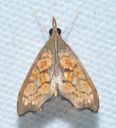
Hydropionea fenestralis is a small crambid described in 1914, with forewings 12–15 mm in length. display a distinctive reticulated wing pattern and are active from May to October. The was long considered a mystery regarding its larval until 2023, when researchers documented it as a seed borer in Agave salmiana fruits in central Mexico—an unusual association given its phylogenetic placement in Glaphyriinae. The moth occurs in mountainous regions of the southwestern United States and Mexico, with confirmed records from Arizona, Mississippi, Durango, Veracruz, and Puebla.
Pronunciation
How to pronounce Hydropionea fenestralis: /haɪdroʊpiˈoʊniə fɛnɪˈstrælɪs/
These audio files are automatically generated. While they are not always 100% accurate, they are a good starting point.
Identification
The reticulated wing pattern distinguishes this from other Hydropionea and most sympatric crambids. The combination of small size (12–15 mm forewing length), slender body with rolled wing posture, and prominent forward-projecting labial palps ('snout') places it within Crambidae. Definitive identification requires examination of genitalia or , as external alone may not separate it from congeneric species.
Images
Appearance
Small with forewings 12–15 mm in length. Wings exhibit a reticulated (net-like) pattern. Labial palps are enlarged, heavily scaled, and project forward in the characteristic 'snout' configuration of Crambidae. Wings at rest are often rolled around the body, giving a slender appearance.
Habitat
Mountain regions and alpine pine forests in the southwestern United States. In central Mexico, occurs in agave areas in the Perote Valley at elevations where Agave salmiana varieties are grown for pulque production. The New Mexico record from 7,000 feet elevation in dry mixed conifer forest with oaks suggests adaptability to montane woodland .
Distribution
United States: Arizona, Mississippi, and New Mexico (Grant County). Mexico: Durango, Veracruz, and Puebla states. Molecular evidence from 2023 confirmed the central Mexican distribution and expanded the known range beyond the originally described Durango .
Seasonality
active from May to October.
Diet
Larvae feed on seeds within fruits of Agave salmiana var. ferox and Agave salmiana subsp. salmiana. This represents the first documented plant for the and the first record of a lepidopteran seed borer associated with Agave in Mexico. feeding habits are unknown.
Host Associations
- Agave salmiana var. ferox - larval seed-feeding in fruits; causes 13.9±19.9% fruit damage
- Agave salmiana subsp. salmiana - larval seed-feeding in fruits; causes 33.2±2% fruit damage
Life Cycle
Last instar larva described from specimens collected in Agave fruits in Mexico. Complete details remain unknown; site and stage undocumented. The 2023 study provided the first description of any stage.
Behavior
are attracted to lights. Larvae are seed borers, feeding internally within Agave fruits rather than on external plant tissues. This endophytic feeding habit is unusual for the Glaphyriinae , whose larvae typically feed on Brassicales.
Ecological Role
Seed of Agave salmiana. Fruit damage averages 13.9–33.2% in cultivated varieties used for pulque production, potentially affecting seed set and agricultural yield of this economically and culturally important crop. The represents a novel trophic interaction as the first lepidopteran documented to exploit Agave seeds.
Human Relevance
Minor agricultural pest in Mexican agave . The affected Agave varieties form the economic and cultural base of pulque production in the Perote Valley region. No significant impact documented in the United States.
Similar Taxa
- Other Hydropionea speciescongeneric share similar size, wing shape, and crambid 'snout' ; require genitalia examination or for separation
- Other Glaphyriinae members share phylogenetic affinities but most feed on Brassicales rather than Agavaceae; plant association may aid identification where ranges overlap
More Details
Phylogenetic anomaly
The Agave association is unexpected given the placement of Hydropionea within Glaphyriinae, a whose larvae predominantly feed on Brassicales. This represents either an evolutionary host shift or suggests that subfamily-level phylogenetic hypotheses may require revision.
Historical knowledge gap
For over a century after its description in 1914, the larval of H. fenestralis remained completely unknown. The 2023 discovery of its seed-boring habit in Agave was facilitated by of larvae collected in Mexican agave fields, illustrating how molecular techniques can resolve long-standing natural history mysteries.
Collection method
Most records derive from blacklight and porch light attraction, a standard technique for sampling crambid .