
Coccotrypes cyperi
Wood & Bright, 1992
seed borer
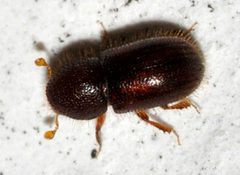
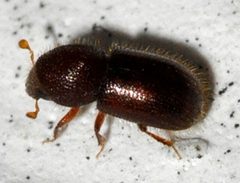
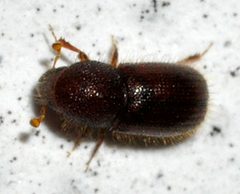
A small weevil in the Curculionidae, commonly known as the seed borer. Native to Southeast Asia, it has established distribution through human-mediated , particularly via international trade in seeds and plant materials. The species is and has been documented from approximately 50 plant species. It is recognized as an pest in multiple regions including the United States, where it was introduced in the early 1900s through imported bird seeds and avocado seeds.
Pronunciation
How to pronounce Coccotrypes cyperi: /kɔk.koʊˈtraɪ.piz ˈsaɪ.pəˌri/
These audio files are automatically generated. While they are not always 100% accurate, they are a good starting point.
Images
Distribution
Native to Southeast Asia (Myanmar, India, China, Indonesia, Malaysia, Sri Lanka, Vietnam). Introduced and established across multiple continents including North America (United States, Mexico), Central America ( Rica, Honduras, Panama), Caribbean (Jamaica, Lesser Antilles, Puerto Rico, Dominican Republic, Saint Vincent and the Grenadines, Saint Lucia, US Virgin Islands, Trinidad and Tobago), South America (Bolivia, Brazil, Ecuador, Chile, Peru, Suriname), Europe (Sweden, Cyprus), Africa (Seychelles), and Oceania (Australia, New Zealand, Papua New Guinea, Cook Islands, Fiji, French Polynesia, Micronesia, Samoa, Tonga).
Diet
Both and larvae are . Larvae bore into soft tissues of fruits, seeds, petioles, phloem, twigs, and under bark of branches and logs. Documented from approximately 50 plant including Ficus microcarpa.
Life Cycle
breed in fruits, seeds, petioles, phloem, twigs, under bark of branches and logs after mating. Larvae develop within these plant tissues, boring into soft tissues. Specific developmental stages and duration not documented in available sources.
Behavior
and larvae exhibit boring into plant tissues. Adults have been intercepted in international plant trade, indicating through human transport of infested plant materials.
Human Relevance
Recognized as an pest . Introduced to the United States in the early 1900s through imported bird seeds and avocado seeds. Intercepted in Cyprus in 2013 and 2015 on Ficus microcarpa plants for planting from China, indicating ongoing risk in international horticultural trade.