
Hydropionea
Hampson, 1917
Species Guides
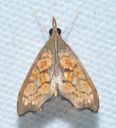
2Hydropionea is a of crambid in the Glaphyriinae. The genus contains at least one well-documented , Hydropionea fenestralis, which exhibits an unusual association for its subfamily. Larvae of H. fenestralis are seed-borers in agave fruits, diverging from the typical Brassicales-feeding habit of Glaphyriinae. The genus is distributed in North America, with records from the southwestern United States and central Mexico.
Pronunciation
How to pronounce Hydropionea: /haɪˌdroʊpiˈoʊniə/
These audio files are automatically generated. While they are not always 100% accurate, they are a good starting point.
Images
Habitat
Dry, mixed conifer forest with oak at elevations around 7,000 feet (based on H. fenestralis records from New Mexico). Agave areas in central Mexico where H. fenestralis has been documented in association with Agave salmiana varieties used for pulque production.
Distribution
North America: southwestern United States (New Mexico, Grant County) and central Mexico (Veracruz and Puebla states).
Diet
For Hydropionea fenestralis: seeds of Agave salmiana var. ferox and Agave salmiana subsp. salmiana fruits. Diet for other in the is unknown.
Host Associations
- Agave salmiana var. ferox - larval (seed borer)Asparagaceae; used for traditional pulque production
- Agave salmiana subsp. salmiana - larval (seed borer)Asparagaceae; used for traditional pulque production
Life Cycle
Last instar of Hydropionea fenestralis has been described. Complete details remain unknown for the .
Behavior
Hydropionea fenestralis are attracted to lights at night. Larvae exhibit seed-boring in agave fruits, causing mean fruit damage of 13.9±19.9% to 33.2±2% in the two documented .
Ecological Role
Hydropionea fenestralis acts as a pest of economically and culturally important agave varieties used for pulque production in central Mexico. It is the first Lepidoptera seed borer recorded on Agave in Mexico.
Human Relevance
Hydropionea fenestralis causes significant damage (up to ~33%) to fruits of agave varieties used for traditional pulque production, impacting the economic and cultural base of the Perote Valley region in Mexico.
Similar Taxa
- Other Glaphyriinae generaHydropionea fenestralis exhibits an unusual association; most Glaphyriinae larvae feed on Brassicales plants rather than Asparagaceae
More Details
Taxonomic placement
Hydropionea is placed in Glaphyriinae ( Crambidae). Some sources list it in Spilomelinae, but recent evidence supports Glaphyriinae placement. The plant association of H. fenestralis with Agave is considered unusual given this phylogenetic position.
Research significance
The first plant record for H. fenestralis was established using and -stage , demonstrating the utility of molecular methods for linking life stages in poorly known .