
Agriphila straminella
(Denis & Schiffermüller, 1775)
Pearl Veneer, Straw Grass-veneer moth
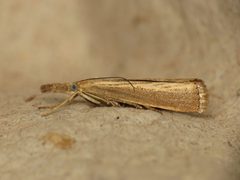
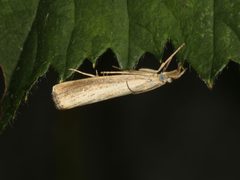
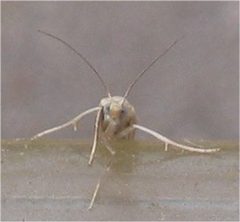
Agriphila straminella is a small crambid with a wingspan of 16–20 mm, found across Europe and the Palearctic region. are active from June to September, with timing varying by location. The is attracted to light traps. Larvae feed on grasses including sheep's fescue, smooth meadowgrass, and wheat.
Pronunciation
How to pronounce Agriphila straminella: /ˌæɡrɪˈfaɪlə ˌstræmɪˈnɛlə/
These audio files are automatically generated. While they are not always 100% accurate, they are a good starting point.
Identification
Distinguished from similar grass-veneer moths (Agriphila spp.) by the combination of: whitish streak on forewing ending in branches along 2–5; two-thirds often suffused with whitish-ochreous; metallic cilia; and dark grey hindwings. The branching pattern of the median streak and the overall brown ground color with contrasting pale dorsal suffusion are key features. Similar such as Agriphila tristella lack this specific streak branching pattern and dorsal coloration.
Images
Habitat
Grasslands, meadows, agricultural fields, and other areas with abundant grasses. Associated with supporting its larval plants including sheep's fescue, smooth meadowgrass, and wheat.
Distribution
Europe and eastward across the Palearctic region. Documented from Belgium (including Brussels-Capital Region, Flemish Region, Walloon Region, and Antwerpen province), United Kingdom (including Wytham Woods, Oxfordshire and Scougal Moor, Isle of Bute, Scotland), and other European countries.
Seasonality
fly from June to September, with exact timing depending on location.
Diet
Larvae feed on various grasses: sheep's fescue (Festuca ovina), smooth meadowgrass (Poa pratensis), and wheat (Triticum aestivum). feeding habits not documented.
Host Associations
- Festuca ovina - larval food plantsheep's fescue
- Poa pratensis - larval food plantsmooth meadowgrass
- Triticum aestivum - larval food plantwheat
Life Cycle
Larval stage feeds on grasses. and other developmental details not documented in available sources. emerge June–September.
Behavior
are attracted to light traps. activity during summer months.
Ecological Role
Larval herbivore on grasses; contributes to nutrient cycling in grassland . Potential minor pest in wheat .
Human Relevance
Minor agricultural significance due to larval feeding on wheat. Subject of genomic research; chromosomally complete assembly of 511.50 Mb published, including 26 chromosomal pseudomolecules and 12,087 protein-coding genes.
Similar Taxa
- Agriphila tristellaSimilar grass-veneer but lacks the characteristic whitish streak branching along 2–5 and the whitish-ochreous suffusion seen in A. straminella.
More Details
Genome sequencing
Chromosomally complete assembly of 511.50 Mb from a male specimen collected in Wytham Woods, Oxfordshire, UK. Assembly includes 26 chromosomal pseudomolecules (25 + Z ), a 15.36 kb mitochondrial genome, and 12,087 protein-coding genes.