
Capperia
Tutt, 1905
Species Guides
3- Capperia evansi(Evans' Plume Moth)
- Capperia ningoris(Hedgenettle Plume Moth)
- Capperia raptor(Pineywoods Geranium Plume Moth)
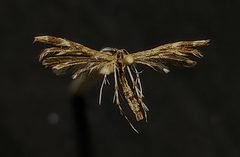
Capperia is a of plume moths in the Pterophoridae, established by Tutt in 1905. are small with wingspans ranging from approximately 12.5 to 20.5 mm. The genus is distributed across Europe, extending into parts of Asia including Kazakhstan and Turkey. Members exhibit periods with active in late spring and mid-summer.
Pronunciation
How to pronounce Capperia: //kæˈpɛɹiə//
These audio files are automatically generated. While they are not always 100% accurate, they are a good starting point.
Identification
Capperia are distinguished from similar plume moths by genitalia . In males, the valvae are conically widened at the middle, and the is strongly S-shaped with a weakly bilobed apex. Females possess a slender 8th sternite and a flat round plate covering the ostium bursae. Capperia fusca is smaller than C. trichodactyla (wingspan 12.5–15.5 mm versus 14.5–20.5 mm) and has dark chocolate brown coloration with reduced white markings.
Images
Habitat
occur in woodland environments including beech and oak-hornbeam forests. The Hungarian record of C. fusca came from an area of former intensive coal mining at 350 m altitude, with adjacent private gardens and small orchards near forested slopes.
Distribution
Europe: Albania, Austria, Belgium, Bulgaria, Crete, Croatia, Czech Republic, France, Greece, Italy, Luxembourg, North Macedonia, Poland, Romania, Russia (South), Slovakia, Spain, Switzerland; Asia: Kazakhstan, Turkey. Hungary represents a recent range extension into the Pannonian biogeographical Region.
Seasonality
fly from mid-May to mid-June and from mid-July to mid-August, indicating two annually. Larvae appear twice yearly, with spring specimens feeding after hibernation and becoming fully grown by late May.
Diet
Larvae feed on Stachys alpina, Stachys cassia, and Marrubium vulgare. Larvae transferred to Stachys sylvatica refused this foodplant and died, indicating specificity despite the close taxonomic relationship of potential hosts.
Host Associations
- Stachys alpina - larval foodplant
- Stachys cassia - larval foodplant
- Marrubium vulgare - larval foodplant
Life Cycle
Larvae emerge twice yearly. Spring larvae feed on stems and lower leaves after , reaching maturity in the second half of May.
Behavior
are active during two discrete periods. Larvae exhibit foodplant specificity, rejecting Stachys sylvatica for reasons that appear chemical rather than physical.
Similar Taxa
- Capperia trichodactylaLarger size (wingspan 14.5–20.5 mm vs. 12.5–15.5 mm in C. fusca) and more extensive white markings distinguish this ; genitalia examination required for definitive identification.
More Details
Host plant specificity
The refusal of Stachys sylvatica by Capperia fusca larvae, despite its close relationship to accepted Stachys alpina and S. cassia, suggests chemically mediated host selection. This specificity was documented by Adamczewski (1951).
Historical habitat disturbance
The Hungarian locality for C. fusca had been subject to intensive coal mining until 2000, with recultivation beginning thereafter, indicating or recolonization capacity in modified environments.