
Neophasia menapia
(Felder & Felder, 1859)
pine white
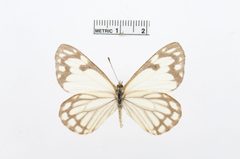
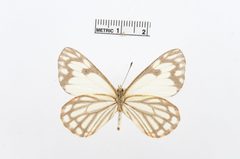
Neophasia menapia, commonly known as the pine white, is a in the Pieridae found in western North America. The species is characterized by white wings with black venation and wing bars, superficially resembling the monarch butterfly (Danaus plexippus). Research indicates N. menapia is palatable to avian , supporting its classification as a likely Batesian mimic rather than a Müllerian co-mimic. The species is , with one summer , and is associated with coniferous forest .

Pronunciation
How to pronounce Neophasia menapia: /niːoʊˈfeɪʒiə mɪˈneɪpiə/
These audio files are automatically generated. While they are not always 100% accurate, they are a good starting point.
Identification
Distinguished from Neophasia terlooii (Chiricahua white/Mexican pine white) by geographic range: N. menapia ranges broadly across western North America while N. terlooii is restricted to sky islands of southeast Arizona and Mexico. Ranges overlap only in New Mexico. N. terlooii exhibits with orange females, whereas N. menapia females remain white with black markings. Distinguished from monarch butterfly (Danaus plexippus) by smaller size, white ground color (vs. orange in monarch), and lack of marginal wing spots.
Images
Appearance
Medium-sized with wingspan of 42–50 mm. Wings are predominantly white with black and black wing bars. Both sexes display similar white coloration with black markings; lacks orange coloration present in female N. terlooii. Wing pattern resembles black venation of monarch butterfly.
Habitat
Coniferous forests, specifically pine forests and Douglas fir forests in northern coastal California. Associated with montane and subalpine coniferous woodlands across its range.
Distribution
Western United States from southern British Columbia, Canada south to California and northern Arizona, east to the Rocky Mountains. Extends to Guadalupe Mountains National Park in extreme southwest Texas. Documented from Kaibab Plateau, Mogollon Rim, and White Mountains in northern Arizona.
Seasonality
with one summer . active in summer months. Timing varies across elevation and latitude within range.
Diet
Larvae feed on conifers including Pinus , Pseudotsuga menziesii (Douglas fir), Tsuga heterophylla (western hemlock), Abies balsamea (balsam fir), Abies grandis (grand fir), and Picea sitchensis (Sitka spruce). feed on flower nectar from rabbitbrush (Ericameria/Chrysothamnus), other yellow-flowered composites (Asteraceae), and monarda (Monarda).
Host Associations
- Pinus - larval plantvarious
- Pseudotsuga menziesii - larval plantDouglas fir
- Tsuga heterophylla - larval plantwestern hemlock
- Abies balsamea - larval plantbalsam fir
- Abies grandis - larval plantgrand fir
- Picea sitchensis - larval plantSitka spruce
- Ericameria - nectar sourcerabbitbrush; formerly Chrysothamnus
- Monarda - nectar source
Life Cycle
producing one per year. Females lay on live pine needles. Larvae develop on conifer plants. and details not documented in available sources.
Behavior
Exhibits weak capacity. observed feeding at flowers. Research indicates the is readily consumed by avian without rejection, though mild behavioral reactions ( shaking, feather ruffling, bill wiping) have been observed in predators post-consumption.
Ecological Role
Larval herbivore on coniferous trees. . Potential Batesian mimic of monarch butterfly (Danaus plexippus); may influence pressure dynamics and geographic range through -prey interactions. Palatability to birds suggests minimal direct chemical defense, with protective value derived from resemblance to unpalatable model .
Human Relevance
Subject of research on mimicry theory and speciation. Temporal isolation and morphological differentiation in sympatric on Goat Mountain and near Seven Troughs Spring, Mendocino Pass area, have been documented as potential case of incipient speciation. Populations in Mendocino National Forest were impacted by 2020 wildfires, with potential local extirpation of late-season morphological variant.
Similar Taxa
- Neophasia terlooii with overlapping range in New Mexico; distinguished by geographic restriction to sky islands of southeast Arizona/Mexico, with orange females, and two
- Danaus plexippusSuperficial wing pattern resemblance; distinguished by larger size, orange ground color, marginal wing spots, and unpalatability to
More Details
Mimicry status
Proposed as mimic of monarch butterfly; empirical testing with captive fish crows (Corvus ossifragus) confirmed palatability comparable to palatable control (Eurema daira). Classification as Batesian mimic supported, though authors note possible quasi-Batesian intermediate status given mild unpalatability evidence.
Incipient speciation
Research by Shapiro and colleagues documented sympatric, temporally isolated on Goat Mountain and near Seven Troughs Spring with morphological and genetic differentiation, flying several weeks apart. Late-season entity populations may have been extirpated by 2020 wildfires.
Subspecies
Multiple recognized: N. m. menapia, N. m. tau (Scudder, 1861), N. m. melanica Scott 1981, N. m. tehachapina Emmel, Emmel & Mattoon 1998, N. m. megamenapia Austin 1998.
Sources and further reading
- BugGuide
- Wikipedia
- GBIF taxonomy match
- iNaturalist taxon
- NCBI Taxonomy
- Catalogue of Life
- Rising from the Ashes--Some Day | Bug Squad
- Bug Eric: December 2010
- Bug Eric: Chiricahua Whites
- Evaluating an Alleged Mimic of the Monarch Butterfly: Neophasia (Lepidoptera: Pieridae) Butterflies are Palatable to Avian Predators