
Anteos maerula
(Fabricius, 1775)
Yellow Angled-Sulphur, angled sulphur
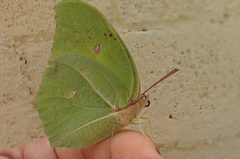
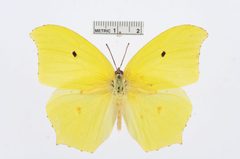
Anteos maerula is a large Pieridae commonly known as the yellow angled-sulphur. Its native range extends from Peru through Central America to Mexico, with occasional vagrant individuals recorded as far north as the central and eastern United States. The is distinguished by its angular wing margins and substantial wingspan, making it one of the larger sulphur butterflies in the Americas.

Pronunciation
How to pronounce Anteos maerula: /ˈæn.ti.oʊs ˈmaɪ.rʊ.lə/
These audio files are automatically generated. While they are not always 100% accurate, they are a good starting point.
Identification
Distinguished from other Anteos and sulphur butterflies by the pronounced angular projection on the hindwing margin. Larger than most North American sulphurs (Phoebis, Colias). The combination of large size, bright yellow coloration, and angled wing edges separates it from the similar but smaller and more rounded Phoebis species. Vagrant individuals in the United States may be confused with Phoebis sennae (cloudless sulphur) but differ in wing shape and size.
Images
Appearance
Large sulphur with wingspan 82–117 mm. Wings are predominantly yellow with angular, somewhat tailed hindwing margins that give the its . The forewings are elongated with pointed apices. Wing shape is distinctive within the , with the hindwing angle more pronounced than in .
Habitat
Tropical and subtropical lowland including forest edges, open woodlands, and disturbed areas with plant availability. In its native range, found in elevations from sea level to moderate montane zones. Migratory individuals in the United States occur in varied habitats including gardens, fields, and riparian corridors.
Distribution
Native range: Peru north through Central America to Mexico. Vagrant records: eastern Nebraska, southeastern Arizona, southwestern New Mexico, southern Texas, Mississippi, and Florida in the United States.
Seasonality
are active year-round in tropical portions of the native range. In the northern United States, vagrant individuals have been recorded primarily during late summer and fall months, coinciding with post-breeding southward movements or weather-displaced migrants.
Diet
Larvae feed on Cassia , including Cassia emarginata. feeding habits not documented in available sources.
Host Associations
- Cassia emarginata - larval plant
- Cassia - larval plant multiple within utilized
Ecological Role
likely function as in native range. Larval herbivory on Cassia contributes to nutrient cycling in tropical . Migratory suggests potential for long-distance between .
Human Relevance
Occasional attraction to gardens and flowering plants in southern Texas and Florida during irruption years. No significant economic impact; not considered a pest . Interest to watchers and collectors due to size and vagrant status in North America.
Similar Taxa
- Phoebis sennaeSimilar yellow coloration and large size, but lacks angular hindwing margins and has more rounded wing shape; also smaller (wingspan 55–70 mm versus 82–117 mm)
- Anteos clorinde with similar angular wing shape, but A. maerula is larger and has more pronounced yellow coloration; ranges overlap in Central America
More Details
Taxonomic history
Originally described as Papilio maerula by Fabricius in 1775, later transferred to Anteos. The genus Anteos contains only two , both characterized by angular hindwing margins.
Migration patterns
Northward vagrancy into the United States appears to be irregular and weather-dependent rather than representing established breeding . Most records are of single individuals.