
Parnassius smintheus
Doubleday, 1847
Rocky Mountain parnassian, Rocky Mountain apollo
Parnassius smintheus is a high-altitude to the Rocky Mountains of North America. It inhabits alpine and subalpine meadows where it depends on Sedum lanceolatum as its primary larval plant. The exhibits pronounced in : males are highly mobile and patrol meadows for females, while females are relatively sedentary and search for oviposition sites primarily by crawling. are strongly influenced by early-winter weather conditions, particularly November temperature extremes and snowfall, which affect survival. Climate change poses significant threats through rising treeline and altered snowpack patterns.
Pronunciation
How to pronounce Parnassius smintheus: /pɑrˈnæsɪəs ˈsmɪnθiːəs/
These audio files are automatically generated. While they are not always 100% accurate, they are a good starting point.
Identification
Distinguished from the closely related Parnassius phoebus by geographic location, with P. smintheus occurring in the central and southern Rocky Mountains while P. phoebus occupies more northern Holarctic regions. P. smintheus can be separated from P. clodius (Clodius parnassian) and P. eversmanni (Eversmann's parnassian) by distribution and subtle differences in wing pattern. Within its range, the combination of white to pale yellow-brown ground color with red and black markings is diagnostic. The shows considerable geographic variation with multiple described .
Images
Appearance
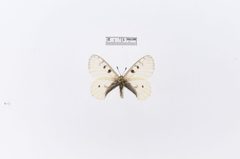
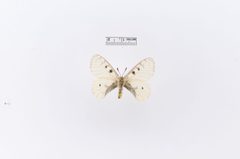
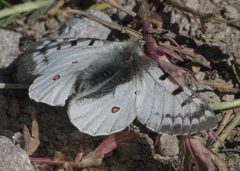
range from white to pale yellow-brown with distinctive red and black markings that serve as aposematic signals of unpalatability. Wingspan measures 2–3 inches (approximately 50–75 mm). The forewing displays a marginal grey band and weakly developed pale grey submarginal band, with small black triangles at each wing . The hindwing may show marginal and submarginal grey markings. Wing fringes are black at vein ends. Both sexes typically bear bright red spots on forewings and hindwings. Higher-elevation tend to have darker females; body size decreases at lower elevations. The body, , legs, and ventral are covered with yellowish hairs and .
Habitat
Restricted to alpine and subalpine meadows, typically 20–40 meters above the tree line. Strongly heliophilic, avoiding forested areas and showing marked edge avoidance—butterflies in meadow avoid forest edges with effects extending nearly 25 meters into meadows. Males prefer meadows with greater abundance of nectar flowers and higher of the plant Sedum lanceolatum, as well as meadows with more females. Females show no preference for nectar flower density or host plant abundance when selecting meadows. Habitat quality and connectivity interact to affect immigration patterns.
Distribution
to the Rocky Mountains of North America, ranging from Yukon, Alaska, and British Columbia in Canada south to New Mexico in the United States. Multiple have been described from different mountain ranges: P. s. behrii (Sierra Nevada), P. s. magnus (Washington state), P. s. maximus (Rocky Mountains), P. s. olympianna (Olympic Mountains, Vancouver Island), P. s. pseudorotgeri (Colorado, San Juan Mountains), P. s. sayii, P. s. smintheus (nominate), P. s. sternitzkyi (North California), and P. s. yukonensis (South Yukon, British Columbia).
Seasonality
with one per year. period extends from early June at low elevations to late September in alpine tundra. emerge in sequence: males emerge from pupae before females to patrol for mates. The mating window for females is brief, approximately three days. undergo embryonic development within one month of oviposition but remain in until snowmelt the following spring. Larval development spans 10–12 weeks across five instars. occurs in late summer, with adults emerging the following year.
Diet
Larvae feed primarily on leaves of Sedum lanceolatum (spearleaf stonecrop), a yellow-flowered succulent. Secondary plants include other stonecrop : S. divergens, S. oreganum, S. stenopetalum, and S. integrifolium. feed on nectar of yellow-flowered species including Potentilla fruticosa, Solidago multiradiata, Senecio canus, and S. lanceolatum. Larvae sequester sarmentosin, a cyanoglycoside defensive compound, from their host plant.
Host Associations
- Sedum lanceolatum - primary larval plantSpearleaf stonecrop; larvae feed on leaves, on nectar. Plant produces sarmentosin, which larvae sequester for defense.
- Sedum divergens - secondary larval plantLess frequently used
- Sedum oreganum - secondary larval plantLess frequently used
- Sedum stenopetalum - secondary larval plantLess frequently used
- Sedum integrifolium - secondary larval plantLess frequently used
- Potentilla fruticosa - nectar source
- Solidago multiradiata - nectar source
- Senecio canus - nectar source
Life Cycle
are white, round, flattened at top and bottom, with pebbled surface and brown sunken micropylar area. Approximately 75 eggs produced per female. Laid on undersides of flower , leaves, sticks, stones, moss, clumps of dirt—typically not on plant itself, often over a meter away. Embryo develops within one month; egg overwinters in , hatching when snow melts. Larvae complete five instars over 10–12 weeks. First instar black with many hairs and dull black head; second instar onward develops conspicuous yellow markings as sarmentosin increases. Fifth instar black with short fine black hairs, two lateral and two rows of bright yellow spots, small pale yellow osmeteria. Pupae dark yellow-brown to red-brown, formed in leaf litter, gravel, or rocks near soil surface without cocoon. emerge using two tiny hooks to break out of pupal site.
Behavior
Males are highly mobile, flying continuously between meadows to locate females and food resources, stopping only to bask or feed. They exhibit poor visual discrimination, investigating any light-colored object of appropriate size. Males patrol large areas and preferentially mate with newly emerged females that have not yet expanded their wings. No courtship ; males forcibly attempt mating upon encountering females, depositing a waxy mating plug (sphragis) containing sperm and nutrients to prevent female remating. Females are largely sedentary, searching for oviposition sites by crawling rather than flying, and retain while traveling to find suitable meadows. Females lay eggs near but not on plants, possibly to avoid associated with the plant. Larvae feed rapidly (typically under 30 minutes per plant) then move to basking sites for ; when disturbed, they twitch violently, drop to ground, and may discharge foul-smelling brown fluid.
Ecological Role
Larvae are likely the sole insect herbivore of Sedum lanceolatum, making them important components of alpine . Their of sarmentosin from plants and subsequent unpalatability to represents a classic example of chemical defense in butterflies. As , they contribute to pollination of alpine meadow plants. The serves as a model organism for studying climate change effects on alpine insects due to its sensitivity to temperature and snowpack variation.
Human Relevance
Subject of extensive ecological research on fragmentation, climate change, and . Used as a flagship for understanding climate change impacts on alpine , particularly regarding treeline encroachment and altered snowpack. Not currently endangered but considered vulnerable to continued climate change; meadow habitat has decreased by over 78% since 1952 in some study areas due to fire suppression and warming. Conservation efforts focus on maintaining meadow connectivity and preventing forest encroachment.
Similar Taxa
- Parnassius phoebusClosely related Holarctic , often misidentified; distinguished primarily by geographic location with P. phoebus occupying more northern ranges
- Parnassius clodiusClodius parnassian; similar wing pattern but different distribution and plant associations
- Parnassius eversmanniEversmann's parnassian; overlaps in some ranges but distinguishable by wing pattern details
More Details
Chemical defense
Both larvae and sequester sarmentosin from Sedum lanceolatum. Adult butterflies contain approximately 460 μg of sarmentosin, concentrated in wings. Sarmentosin concentration is nearly three times higher than in the related P. apollo. The compound causes butterflies to emit strong odor and excrete brown irritant fluid when attacked.
Climate vulnerability
growth is most strongly affected by extreme minimum and maximum temperatures in November, combined with November snowfall. Warm Novembers and short-term temperature extremes cause population declines. Premature hatching due to early snowmelt followed by cold temperatures causes larval mortality.
Mating system
Approximately 14% of females never mate. Female mating success correlates with , though results vary across studies. The mating plug (sphragis) does not appear to affect female , suggesting its primary function is mate guarding rather than nutrient provision.
Sources and further reading
- BugGuide
- Wikipedia
- GBIF taxonomy match
- iNaturalist taxon
- NCBI Taxonomy
- Catalogue of Life
- Meet a UC Davis Student Who Is Researching the Cold-Adapted Parnassian Butterflies | Bug Squad
- How the UC Davis Research Scholars Program in Insect Biology Shines | Bug Squad
- Congrats to 4 Outstanding UC Davis Student Entomologists: Recipients of NSF-GRFP Grants | Bug Squad
- A Mid-Winter Gathering of Lepidopterists at Bohart Museum | Bug Squad
- Alpine insects | Blog
- Acta Biologica Sibirica | Blog
- MIGRATION AND SURVIVAL OF PARNASSIUS SMINTHEUS: DETECTING EFFECTS OF HABITAT FOR INDIVIDUAL BUTTERFLIES
- Edge avoidance and movement of the butterfly Parnassius smintheus in matrix and non-matrix habitat
- Dispersing maleParnassius smintheusbutterflies are more strongly affected by forest matrix than are females
- Effects of meadow suitability on female behaviour in the alpine butterfly Parnassius smintheus
- Effects of experimental population removal for the spatial population ecology of the alpine butterfly,Parnassius smintheus
- UV-induced anthocyanin in the host plant Sedum lanceolatum has little effect on feeding by larval Parnassius smintheus
- An experimental examination of the effects of habitat quality on the dispersal and local abundance of the butterfly Parnassius smintheus
- Genetic differentiation and gene flow among populations of the alpine butterfly, Parnassius smintheus, vary with landscape connectivity
- Mating failure of female Parnassius smintheus butterflies: a component but not a demographic Allee effect
- Pivotal effect of early‐winter temperatures and snowfall on population growth of alpineParnassius smintheusbutterflies
- Interactions between habitat quality and connectivity affect immigration but not abundance or population growth of the butterfly, Parnassius smintheus
- Extremes of snow and temperature affect patterns of genetic diversity and differentiation in the alpine butterfly Parnassius smintheus
- The Effects of Isolation, Habitat Area and Resources on the Abundance, Density and Movement of the Butterfly Parnassius smintheus