
Parnassius clodius
Ménétriés, 1855
Clodius Parnassian, American Apollo
Species Guides
1- Parnassius clodius strohbeeni(Strohbeen's Parnassian)
Parnassius clodius is a cold-adapted white in the snow Apollo , found in western North America from sea level to alpine zones. It inhabits diverse environments including coastal forests, sagebrush meadows, and subalpine . The is a model organism for studying thermal and climate change impacts on high-elevation insects. are poor dispersers with limited between . Larvae are specialized herbivores of Dicentra species and exhibit behavioral .
Pronunciation
How to pronounce Parnassius clodius: //pɑrˈnæs.i.əs ˈkloʊ.di.əs//
These audio files are automatically generated. While they are not always 100% accurate, they are a good starting point.
Identification
Identification complicated by extensive subspecific variation and phenotypic plasticity. Structural characters from genitalia, wing venation, sphragis, and foretibial epiphysis provide more reliable identification than wing pattern alone. Males produce large waxy vaginal plug (sphragis) that prevents female remating. Distinguished from similar Parnassius by combination of geographic range, association, and specific wing pattern elements; however, identification often requires examination of genitalic structures.
Images
Appearance
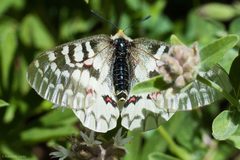
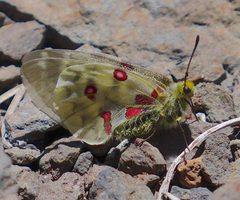
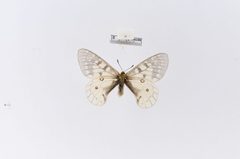
Ground color white with variable black markings. Male forewing has small submarginal spots; female has larger crescent-shaped submarginal spots on hindwing. Female with short costal band outside connected to hindmarginal spot by irregular dusty band. submarginal band on forewing narrow but sharply defined. Hindwing anal spot typically centered with red in most . Higher-elevation specimens consistently smaller than low-elevation . Wing pattern highly variable across subspecies.
Habitat
Occupies diverse across elevation gradient: cool mesic mixed forest and streamsides at lower elevations; moist conifer forest, meadow edges, and sagebrush meadows at mid elevations; rocky slopes and alpine areas near and above treeline. P. c. strohbeeni inhabited atypical low-elevation redwood canyons. Requires presence of larval plants in suitable microclimates.
Distribution
Western North America: British Columbia, Washington, Oregon, Nevada, California, Wyoming, Montana, and Utah. Disjunct in protected areas including North Cascades National Park, Grand Teton National Park, Yosemite National Park, and Greater Yellowstone . with restricted ranges: P. c. altaurus in Wyoming; P. c. shepardi in Washington; P. c. incredibilis on Mount St. Elias, Alaska; P. c. menetriesii in Utah; extinct P. c. strohbeeni formerly in Santa Cruz Mountains, California.
Seasonality
One annually. period varies with elevation: May-June at low elevations, June-August at high elevations, rarely later. active during daylight hours. stage is the , in .
Diet
Larvae are herbivores feeding on Dicentra (Papaveraceae), including Dicentra uniflora (longhorn steer's ) and Dicentra formosa (Pacific bleeding-). feed on nectar from diverse flowering plants including Eriogonum umbellatum, Yerba Santa, and Coyotemint.
Host Associations
- Dicentra uniflora - larval plantlonghorn steer's
- Dicentra formosa - larval plantPacific bleeding-; for extinct P. c. strohbeeni
- Eriogonum umbellatum - nectar sourceprimary nectar source in some
Life Cycle
stage overwinters in , with supercooling points around -30°C in mid-elevation indicating substantial cold . Larvae develop under cold macroclimatic conditions and demonstrate active behavioral , becoming - except on cloudy, cool days when they may feed diurnally. Larvae reportedly mimic poisonous millipedes in appearance. and timed to local climatic conditions. Single .
Behavior
are poor dispersers with average straight-line movement of approximately 202 meters per day. Males do not hilltop. Larvae exhibit behavioral , adjusting activity patterns to thermal conditions. Larvae are sole insect herbivore on plants, facilitating field identification of microhabitats.
Ecological Role
Larval herbivore on Dicentra ; likely the only insect herbivore on these plants in its range. visiting diverse flowering plants. Poor limits , creating fine- structure and metapopulation dynamics. Serves as for climate change impacts on alpine and subalpine .
Human Relevance
Subject of intensive research on thermal , climate change, and conservation . Model organism for studying cold in insects. Some of conservation concern; P. c. strohbeeni extinct due to destruction from road construction, summer home development, and nursery trade. Research informs management of protected areas including national parks.
Similar Taxa
- Parnassius behriiCalifornia found at higher elevations (mostly above 9,000 feet); distribution with limited overlap
- Parnassius smintheusoverlapping range in western North America; distinguished by wing pattern and genitalic structures
- Parnassius phoebussimilar alpine and appearance; geographic separation and subtle wing pattern differences
More Details
Climate Change Vulnerability
The Parnassius is particularly vulnerable to global warming due to affinity for alpine and arctic . Rising treelines threaten to eliminate habitat for high-elevation with nowhere to move upward. demonstrates phenotypic plasticity in melanin content correlated with temperature and solar radiation, consistent with thermal melanism hypothesis.
Population Structure
Fine- genetic structure documented across three protected regions (North Cascades, Grand Teton, Yosemite). Network analyses reveal Grand Teton and Yosemite subpopulations more vulnerable to perturbations. Environmental variation contributes to genetic differentiation beyond geographic distance alone.
Extinct Subspecies
P. c. strohbeeni, described from Santa Cruz Mountains, California in 1923, is extinct. Last individual observed near Bonny Doon, Mount Len Lemond. Extinction attributed to destruction from road construction, summer home development, and nursery trade affecting plant .
Research Significance
Increasingly important model for physiological, ecological, and evolutionary study of cold-adapted organisms. Research on P. clodius informs understanding of thermal limits, microclimatic , and persistence under climate change.
Sources and further reading
- BugGuide
- Wikipedia
- GBIF taxonomy match
- iNaturalist taxon
- NCBI Taxonomy
- Catalogue of Life
- Meet a UC Davis Student Who Is Researching the Cold-Adapted Parnassian Butterflies | Bug Squad
- How the UC Davis Research Scholars Program in Insect Biology Shines | Bug Squad
- Congrats to 4 Outstanding UC Davis Student Entomologists: Recipients of NSF-GRFP Grants | Bug Squad
- A Mid-Winter Gathering of Lepidopterists at Bohart Museum | Bug Squad
- Alpine insects | Blog
- Acta Biologica Sibirica | Blog
- Summary of an Ongoing Population Study of Parnassius Clodius Butterflies
- Survival, movement, and resource use of the butterfly Parnassius clodius
- Testing the role of ecological selection on colour pattern variation in the butterflyParnassius clodius
- Investigating movement and population genetic structure of Parnassius clodius butterflies in Grand Teton National Park
- Combining multiscale replication in network and landscape-genetic analyses to assess functional connectivity and population resilience in Parnassius clodius butterflies