
Neonympha areolatus
(J.E. Smith, 1797)
Georgia Satyr
Neonympha areolatus, commonly known as the Georgia satyr, is a in the Nymphalidae. It is native to North America, with concentrated in the southeastern United States. The inhabits wetland and grassland , particularly areas with sedges. Like other satyrs, it exhibits a low, bouncing pattern and often rests with wings closed.


Pronunciation
How to pronounce Neonympha areolatus: /niːəˈnɪmfə æriˈɒleɪtəs/
These audio files are automatically generated. While they are not always 100% accurate, they are a good starting point.
Identification
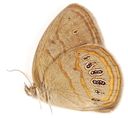
Distinguished from the closely related Mitchell's satyr (Neonympha mitchellii) and Saint Francis satyr (Neonympha mitchellii francisci) by geographic range and subtle wing pattern differences. The Georgia satyr occurs further south and east than Mitchell's satyr. The eyespot pattern on the hindwing underside—typically two prominent eyespots—helps separate it from some Euptychia with which it has been historically confused. The low, bouncing near the ground is characteristic of satyr butterflies in general.
Images
Appearance
A small to medium-sized brown with rounded wings. The upperside is generally uniform brown. The underside features eyespots on both forewings and hindwings, with the hindwing typically displaying two prominent eyespots with yellowish rings. The wing margins are relatively smooth without strong angular projections.
Habitat
Wetland edges, moist grasslands, and sedge meadows. Associated with containing Carex (sedge) , which serve as larval plants. Requires open, sunny areas with low vegetation and access to moist soils.
Distribution
Southeastern United States, from southern New Jersey south to Florida and west to eastern Texas and Oklahoma. Range extends northward along the Atlantic coastal plain.
Seasonality
Multiple per year, with active from late spring through early fall. Peak periods vary by latitude, occurring earlier in the southern portion of the range.
Diet
feed on nectar from flowers and possibly moisture from damp ground. Larvae feed on sedges (Carex ).
Host Associations
- Carex - larval plantspecific sedge used varies by region
Life Cycle
Complete with four stages: , larva, pupa, and . Larvae feed on sedges and overwinter in larval or pupal stage depending on timing. Multiple per year in most of the range.
Behavior
fly low to the ground with a characteristic slow, bouncing pattern. Frequently rest on vegetation with wings closed, displaying the eyespot-patterned undersides. Males patrol territories in search of females.
Ecological Role
may contribute to pollination of low-growing flowers. Larvae serve as herbivores in wetland , converting sedge to animal tissue available to . The functions as an indicator of healthy wetland and grassland .
Human Relevance
Subject of conservation concern due to loss from wetland drainage and development. Used as a study organism for landscape corridor research and habitat restoration effectiveness. The MONA ( of North America) or Hodges number is 4576.
Similar Taxa
- Neonympha mitchelliiMitchell's satyr overlaps in range in some areas; distinguished by more northerly distribution and subtle differences in eyespot size and arrangement
- Neonympha mitchellii francisciSaint Francis satyr is federally endangered and restricted to a small area in North Carolina; historically confused with Georgia satyr but now recognized as distinct
- Euptychia phocionHistorically treated as congeneric; Georgia satyr was formerly placed in Euptychia, but current places it in Neonympha based on morphological and molecular data
More Details
Taxonomic Note
This has undergone taxonomic revision. GBIF currently lists Neonympha areolatus as a synonym of Euptychia phocion, but NCBI and most North American lepidopteran resources maintain it in Neonympha. The Neonympha is currently restricted to a small group of North American satyrs, while Euptychia is primarily Neotropical.
Conservation Status
Not federally listed, but are declining in parts of the range due to loss. Research by Nick Haddad and colleagues at North Carolina State University has used this and related to study landscape corridor effects on and population viability.